In this guide
Amsterdam at a Glance
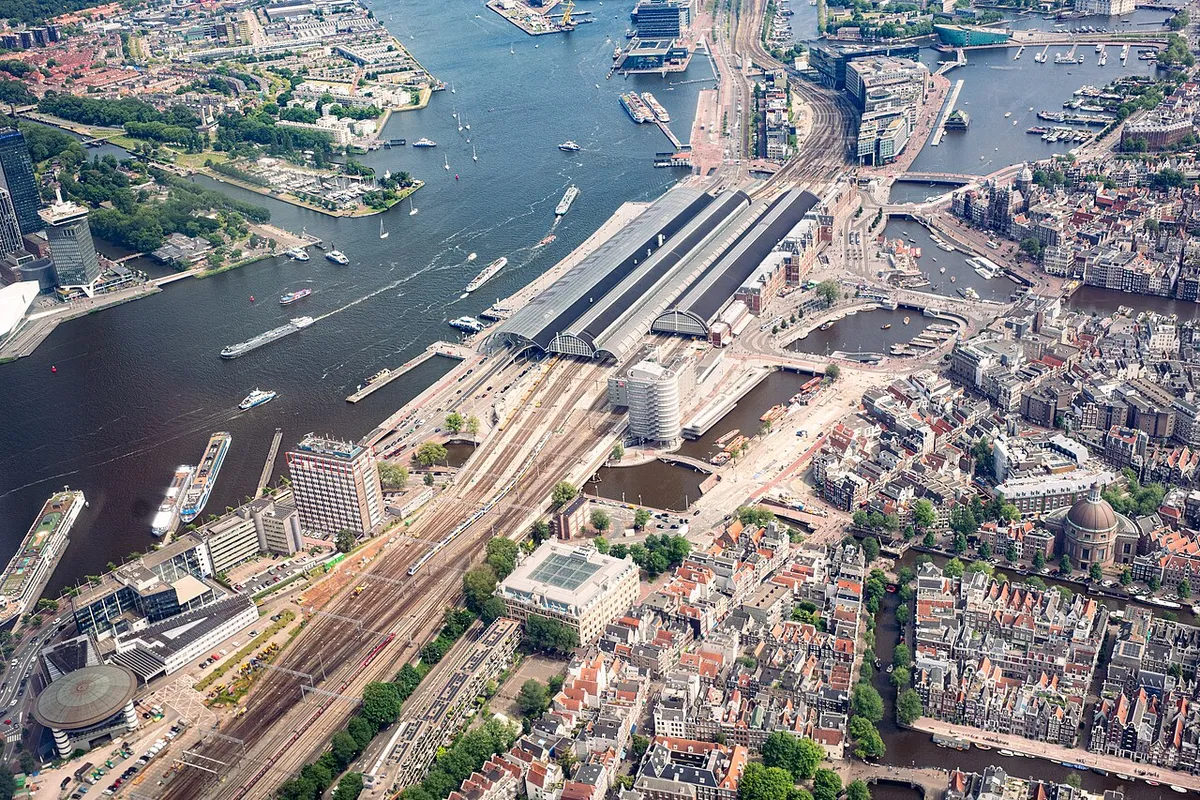 Photo: Amsterdam, the Netherlands. Source: Wikimedia Commons.
- Population: about 940,000 residents at the start of 2026 (OIS Amsterdam)
- International mix: around 59% of residents had a migration background on 1 January 2024 (OIS Amsterdam)
- Main languages spoken: Dutch, English (near-universal in the city centre), and dozens of others
- Key industries: technology, financial services, creative industries, tourism
- Average commute: 25–35 minutes by bike or public transport
Amsterdam is the most international city in the Netherlands, and in many ways the easiest soft landing for new arrivals. English works almost everywhere, the expat infrastructure is well established, and there is no shortage of people who have made the same move you are about to make. The downside is equally obvious: it is expensive, housing is genuinely difficult to find, and the city can feel saturated with short-term residents who are passing through rather than putting down roots.
Cost of Living
On this site Amsterdam is the benchmark the rest of the country gets compared against. For rent, Pararius’s Q2 2026 Huurmonitor puts Amsterdam at €28.69 per square metre per month for new tenants in the free sector, the highest of the Dutch cities it reports. That is worth stating plainly, because it also means Amsterdam is the city where the gap between a headline salary and what is left after rent is widest.
The section below is deliberately split into three parts, because the three parts have very different levels of certainty. Rent is an editorial market indication — a range, not a measured average, and the single number most likely to be wrong for your specific flat. The national fixed costs (health insurance, groceries, utilities, connectivity, transport) are identical in every Dutch city; there is no Amsterdam premium on a health insurance policy or a mobile contract. The only genuinely city-specific numbers that can be verified line by line are the municipal and water authority charges, which are set annually in published tax ordinances and are therefore the one part of a Dutch cost-of-living estimate that is not an estimate at all.
Read in that order, the picture for Amsterdam is straightforward: your rent is the expensive part, your fixed costs are the same as they would be in Eindhoven, and your local tax bill — roughly €53 to €78 a month — is a rounding error by comparison, but one that catches people out because nobody mentions it before you sign.
Rent (base rent, editorial market indication)
| Item | Estimated monthly cost |
|---|---|
| 1-bedroom apartment (private rental) | €1,500–€1,800 |
| 2-bedroom apartment | €2,000–€2,400 |
| GVB Vrij monthly pass (adults 19+, OVpay) | €129 |
Editorial market indication for private-sector rentals, ExpatNetherlandsHub, August 2026 — base rent excluding servicekosten and utilities. Individual listings vary widely by neighbourhood, energy label and furnishing.
The rent figures above are indications, not measured averages — location within the city makes a significant difference. A 1-bedroom in De Pijp will cost more than the same size in Noord or Oost. Service costs (servicekosten) on top of base rent are common, and they are not included in the ranges above; ask for the amount before you sign.
If you are arriving without a full apartment budget, or you want a room or studio while you look for something permanent, the shared-rental market is a separate market with its own platforms.
Disclosure: the link below is an affiliate link. If you sign up through it we may earn a commission at no extra cost to you. It does not change what we recommend.
Search rooms and studios on Kamernet →
The costs that are the same in every Dutch city
Except for health insurance, which is a published national average, the ranges below are planning assumptions from this site’s own Cost of Living in the Netherlands 2026 guide, not measured figures. They are used unchanged for every city because none of them vary by postcode; check your own bills and the providers’ current prices.
| Component | Single | Couple | Family (2 adults + 2 children) |
|---|---|---|---|
| Health insurance (basic policy, per adult; Rijksoverheid average 2026) | €157 | €314 | €314 (children under 18 free) |
| Groceries | €250–€350 | €400–€550 | €600–€850 |
| Utilities (gas, electricity, water) | €150–€250 | €180–€280 | €220–€350 |
| Internet + mobile | €50–€80 | €70–€110 | €80–€130 |
| Transport (OV + bike) | €100–€200 | €150–€300 | €200–€400 |
The midpoints used in the totals further down are:
- Single: €872/month = 157 + 300 + 200 + 65 + 150
- Couple: €1,334/month = 314 + 475 + 230 + 90 + 225
- Family: €1,729/month = 314 + 725 + 285 + 105 + 300
On health insurance specifically: the Rijksoverheid puts the 2026 average basic premium at €157 per month, and the statutory deductible (eigen risico) is €385 per year. The cover is legally identical whichever insurer you pick, so any premium below the average is pure saving. Use the Health Insurance Wizard to compare, and note that children under 18 are covered free on a parent’s policy, which is why the couple and family rows for insurance are the same number.
Local charges: the one number that really is city-specific
| Charge 2026 | Single (1 person) | Couple (2 persons) | Family (4 persons) | Ordinance |
|---|---|---|---|---|
| Afvalstoffenheffing (waste levy) | €352.00 | €469.00 | €469.00 | Verordening Afvalstoffenheffing en Reinigingsrecht Bedrijfsafval Amsterdam 2026, art. 5 |
| Rioolheffing (sewerage) — tenant | €0 | €0 | €0 | Verordening rioolheffing Amsterdam |
| Rioolheffing — owner pays | €192.04 | €192.04 | €192.04 | as above |
| Watersysteemheffing ingezetenen (per home) | €186.85 | €186.85 | €186.85 | Waterschap Amstel, Gooi en Vecht |
| Zuiveringsheffing (€92.79 per v.e.) | €92.79 (1 v.e.) | €278.37 (3 v.e.) | €278.37 (3 v.e.) | Waterschap Amstel, Gooi en Vecht |
Four things are worth understanding here, because they are the things Dutch landlords rarely explain.
The waste levy is the tenant’s bill. Gemeente Amsterdam charges it to the household that uses the property, not to the owner. A single occupant pays €352.00 for 2026; any household of two or more pays €469.00, whether that is a couple or a family of five.
The sewerage charge in Amsterdam is levied on the owner, so as a tenant you pay €0. The owner’s portion is €192.04 for 2026, and there is a user portion only for properties discharging more than 300 m³ of water a year — which no normal household does. Expats routinely budget for a rioolheffing bill they will never receive; if you are renting in Amsterdam, that money stays in your account and your landlord pays it.
The waterschap bill is a separate bill from the gemeente bill, and tenants pay both of its parts. Amsterdam falls under Waterschap Amstel, Gooi en Vecht. You get charged a flat watersysteemheffing of €186.85 per home for living behind the dykes, plus a zuiveringsheffing for treating your wastewater. Two envelopes, two payment references, two moments of confusion in your first year.
The 1 v.e. / 3 v.e. rule explains the steep jump from single to couple. The zuiveringsheffing is charged per pollution unit (vervuilingseenheid). A home occupied by one person counts as 1 v.e.; a home occupied by more than one person counts as 3 v.e., however many more there are. At €92.79 per unit, that is €92.79 for a single occupant and €278.37 the moment a second person registers at the address — the same €278.37 a family of five pays. It is not a per-person charge and it is not a mistake.
Combined, the bills an Amsterdam tenant actually receives come to:
| Household | Per year | Per month |
|---|---|---|
| Single | €631.64 | ~€53 |
| Couple | €934.22 | ~€78 |
| Family of four | €934.22 | ~€78 |
For a wider breakdown of recurring local charges and living costs, see our cost-of-living guide. Check Amsterdam’s assessment and remission pages for the current local procedure.
Monthly total by household profile
| Profile | Rent | National fixed costs | Local charges | Total |
|---|---|---|---|---|
| Single, 1-bedroom | €1,650 | €872 | €53 | €2,575 |
| Couple, 1-bedroom | €1,650 | €1,334 | €78 | €3,062 |
| Family of four, 2-bedroom | €2,200 | €1,729 | €78 | €4,007 |
The arithmetic is shown so you can re-add it: 1,650 + 872 + 53 = €2,575; 1,650 + 1,334 + 78 = €3,062; 2,200 + 1,729 + 78 = €4,007. Rent is the midpoint of the ranges above.
What these totals exclude, and you should budget separately for: income tax and the effect of the 30% ruling; one-off setup costs, which in the Netherlands are substantial — deposit of one to two months’ rent, furnishing an unfurnished Dutch rental (many come without flooring or light fittings), and an agency fee where one applies; childcare; international school fees, which each school sets; and any car.
Municipal and water authority tariffs above are the 2026 rates as adopted in each body’s own tax ordinance, retrieved from lokaleregelgeving.overheid.nl on 21 August 2026. Rent figures are an editorial market indication, not a measured average. Local rates are reset every year — check your own assessment.
Before committing to a budget, use the Housing Budget Checker to model what you can realistically afford based on your income, and the Cost of Living Calculator to compare Amsterdam against the other cities on this site. For the income side, the Salary Checker and the 30% Ruling Calculator tell you what actually lands in your account. For the search itself, see Moving to Amsterdam: Full Guide 2026 and finding housing in the Netherlands. If you pay a deposit from a foreign account, compare the provider’s live quote and confirm that the recipient details and transfer route are supported.
Best Neighbourhoods for Expats
De Pijp — The most internationally mixed neighbourhood in the city. High density of cafés, markets (Albert Cuyp), and restaurants. Rents are among the higher ones in the city. Popular with young professionals and families alike.
Oud-West — Quieter than De Pijp but similarly well-connected. Good schools, independent shops, and cycling distance from the centre. Rents are comparable to De Pijp.
Jordaan — Historically the most sought-after address in the city. Canal houses, small galleries, and independent restaurants. Rents reflect the demand.
Amsterdam Noord — The most affordable option on this list. Accessible via the free ferry from Centraal Station (5 minutes), Noord has grown considerably in the last decade. Rents tend to be lower than in the central districts. Good option if you work remotely or your employer is based north of the IJ.
Amsterdam Oost — Popular with families and longer-term expats. Oosterpark area is green, well-connected, and slightly calmer than the canal belt. Check current listings for rents.
Working in Amsterdam
Amsterdam’s economy is concentrated in a few areas. Tech is the largest growth sector — major employers include Booking.com, Adyen, TomTom, and a large number of international companies that have set up European headquarters here (Netflix, Uber, Tesla, and many others). Financial services remain significant, with ABN AMRO, ING, and a range of asset managers based in the city. Creative and media industries are also well represented.
The salary range is wide depending on sector. Tech salaries in Amsterdam are competitive by Dutch standards but do not always keep pace with housing costs for mid-level roles — something worth factoring into your planning before you arrive.
Major coworking spaces include WeWork (multiple locations), B. Amsterdam in Westpoort, and Spaces (several sites). Check each space’s current day pass and membership prices.
For salary benchmarking, use the Salary Checker before negotiating your contract. Use the 30% Ruling Calculator to see how much tax you could save. If you have a foreign degree, check recognition requirements with the Diploma Evaluator. See also the Working in the Netherlands guide.
Getting Registered
Registration in Amsterdam is handled through the Gemeente Amsterdam. You need a fixed address before you can register — this is the catch-22 that catches many new arrivals. If you are staying in temporary accommodation, check whether your landlord will allow registration at that address.
Book your appointment at the Stadsloket as early as possible. Waiting times vary, so check the earliest available date. You will need your passport, rental contract, and proof of income or employment. Your BSN number is issued on the day of registration and is needed for opening a bank account, accessing healthcare, and signing contracts.
Not sure which visa you need? Use the Visa Checker to find out. Use the BSN Planner to prepare your documents and understand the exact steps before your appointment. Planning your integration path? Use the Inburgering Route Planner to see your requirements.
Healthcare & Insurance
The main hospitals in Amsterdam are Amsterdam UMC (two campuses: AMC and VUmc), and OLVG (East and West). For day-to-day medical care, you register with a GP (huisarts) in your neighbourhood — most practices have some English-speaking capacity, though not all.
Finding an English-speaking GP can take time. The Amsterdam Health Base and a number of Centrum-area practices advertise English-language consultations. Expect registration waiting lists of 4–8 weeks in popular neighbourhoods.
Dutch health insurance is mandatory: take it out as soon as you can and no later than 4 months after arriving, with cover from the day you arrived (Government.nl). Use the Health Insurance Wizard to compare policies and find one suited to expats — the average basic premium is €157 per month, and the annual deductible (eigen risico) is €385 in 2026. Compare Dutch and international expat insurance options with the Insurance Comparison.
Transport
Amsterdam is one of the most cycle-friendly cities in the world — this is not an exaggeration. The majority of residents cycle for daily trips, including in winter. A reliable second-hand bike costs €100–€200 and is a sound investment.
For longer journeys, Amsterdam is exceptionally well-connected by rail. Intercity trains connect the city with Rotterdam, Utrecht, The Hague and Eindhoven, and Schiphol Airport has its own train station. Check the NS journey planner for current routes and times, as some Intercity Direct services no longer call at Amsterdam Centraal.
Within the city, GVB operates trams, metro, and buses. The OV-chipkaart is the standard payment method. See the OV-chipkaart guide for expats for a full breakdown of how the system works.
Practical Tips for Your First Weeks
Get a bike immediately. Amsterdam is a cycling city before it is anything else. Within the first week, find a second-hand bike — Waterlooplein market, MacBike second-hand, or local Facebook groups are the quickest sources. Budget €100–€200 for something reliable. Invest in a good lock (Abus or Kryptonite at minimum €50) — bike theft is a genuine problem, and locking to a fixed object with two locks is standard practice.
Use the OV-chipkaart from day one. Buying single-use paper tickets on GVB trams and buses is significantly more expensive than using an OV-chipkaart. Get one online or at the station on arrival. See the OV-chipkaart guide for expats for full setup instructions.
Know the difference between inschrijven and verhuizen. If you are moving to Amsterdam from another Dutch city, you do not need a full first-registration appointment — you need to report a change of address (adreswijziging or verhuizen). This can be done online through the Amsterdam municipality website if you have a DigiD, and is faster than the in-person first-registration process.
Understand the service cost (servicekosten) on your rent. Many Amsterdam rentals quote a base rent plus monthly service costs for maintenance, building insurance, and sometimes gas/water. Always ask for the breakdown — the total cost including servicekosten is what matters for your budget.
Register your bike theft with Velotak or a similar service. It takes five minutes and creates a traceable record if your bike is stolen, which is relevant if you eventually want to claim on insurance. Bike insurance in Amsterdam costs roughly €50–€80 per year for a standard city bike and is worth considering once you have invested in something decent.
Getting Started in Amsterdam
Moving to Amsterdam requires a few first steps. Here are the most important ones:
Arrange payment details — A Dutch bank account is convenient for local payments, but a reachable SEPA account cannot simply be rejected because its IBAN is from another Member State. Wise gives verified customers EUR account details with a non-Dutch euro IBAN (Wise uses a Belgian BIC and address) rather than an NL IBAN. Open a Wise account → Use the Bank Account Comparison to find the right Dutch bank for your situation.
Get health insurance — Dutch health insurance (zorgverzekering) is mandatory. The basic package is the same at every insurer, so compare premium, policy type and supplementary cover. Compare Dutch health insurance options with our Health Insurance Wizard →
Consider expat insurance — If you’re still settling in or working remotely, SafetyWing provides global health coverage; check its website for current prices and what is included. Get SafetyWing coverage →
Plan your budget — Use our free cost of living calculator and housing budget checker to see what you can afford in Amsterdam.
Expat Community & Social Life
Amsterdam has one of the most developed expat communities in Europe. The infrastructure — meetups, sports clubs, professional networks, language exchanges — is extensive, though it takes some initiative to tap into it.
The expat Facebook groups for Amsterdam are active and genuinely useful for practical questions. InterNations Amsterdam is one of the larger organised communities for international residents, with regular events across different sectors and age groups. LinkedIn is widely used for professional networking across most sectors.
Language is rarely a barrier in the city, which is both a convenience and a risk. It means you can build an entirely English-language life without friction — and many people do, for years. Whether that matters depends on your goals. If you want to integrate beyond the expat bubble, putting effort into Dutch will open a different category of social and professional access, and Dutch language schools in Amsterdam are widely available.
Sports clubs are a good entry point into mixed Dutch-expat social life. The city has a large number of running clubs, football teams, rowing associations (the Amstel is popular for rowing and dragon boat racing), and cycling groups. Most have English-speaking members at all levels.
Schools and Families
For expats with children, Amsterdam has a substantial international education offer. The International School of Amsterdam (ISA) is the most established, offering the International Baccalaureate from early years through to diploma level. The British School of Amsterdam covers the UK curriculum. Several European schools also operate in or near the city.
These schools are expensive — each school sets its own annual fees, so check the fee page. If your employer covers school fees as part of a relocation package, confirm the amount before you commit to a school. Waiting lists for the most popular international schools in Amsterdam can be long — register as early as possible, ideally before you arrive.
Dutch state schools are an alternative for families planning a longer stay. Many have integration support for non-Dutch speaking children, and a number of primary schools in internationally mixed neighbourhoods — De Pijp, Oost, Oud-West — have experience with new arrivals. This route works better if your children are young and likely to be in the country for more than a few years.
Housing Search: Practical Advice
The Amsterdam housing market is competitive at every price point. A few things that help in practice:
Search platforms used by most landlords and agencies include Pararius, Funda (primarily for buying but also rentals), and Kamernet (for rooms and smaller apartments). Estate agents (makelaars) who specialise in expat relocation include a number of English-speaking firms in the city — ask about their fees before you sign anything — and they can provide access to listings not yet publicly advertised.
You will almost certainly need to show proof of income — typically three months of recent payslips and a current employment contract. Employers in the Netherlands often provide an employer declaration (werkgeversverklaring) confirming your salary and contract status. Get this ready before you start viewing.
Many landlords ask for a deposit (borg) of one to two months’ rent. Under Dutch law, the deposit must be returned within 14 days of the end of the tenancy unless there are legitimate deductions.
If you are arriving from outside the EU and your residence permit is pending, some landlords will decline to sign until the permit is in hand. Plan for this and have temporary accommodation arranged as a buffer.
Finding Housing in Amsterdam: What Actually Works
Prepare your documents package before you view a single property. This means: three months of recent payslips, a signed employment contract, an employer declaration (werkgeversverklaring) confirming your salary and contract duration, a copy of your passport, and a recent bank statement. Have these ready as a PDF you can email within the hour of a viewing — because that is often what is required.
Register on Pararius, Funda, and direct agency mailing lists simultaneously. Set up search alerts. Popular listings can receive many responses quickly, so respond as soon as you can.
Private landlords are increasingly common in Amsterdam as institutional investors have sold properties under the Affordable Rent Act (Wet betaalbare huur), which has capped rents on mid-market properties since 1 July 2024 (new contracts signed on or after that date). This has pushed some landlords to sell, reducing supply. The cap applies to properties with a WWS (woningwaarderingsstelsel) score below a certain threshold — in practice, this means many Amsterdam apartments under €1,200/month are now technically regulated. Your real estate agent can advise on whether a property falls under the cap.
Settling In: The First Month
The practical sequence most expats in Amsterdam follow for the first few weeks:
- Secure housing with a rental contract that allows municipality registration
- Book registration appointment at the Stadsloket (available online at amsterdam.nl)
- Attend registration, receive your BSN
- Open a Dutch bank account using your BSN and rental contract
- Register for health insurance (mandatory within four months of arriving, but do it immediately)
- Register with a GP (huisarts) — this can take a few weeks, so do it early
- Apply for a DigiD (digital identity for Dutch government services) — used for filing taxes, accessing your healthcare records, and almost everything else official
The DigiD application takes about a week as a letter is sent to your registered address. Don’t delay this — it unlocks a large amount of digital access that otherwise requires in-person appointments.
Frequently Asked Questions
How much is the waste tax in Amsterdam in 2026?
The afvalstoffenheffing for 2026 is €352.00 a year for a one-person household and €469.00 for any household of two or more people, according to the Verordening Afvalstoffenheffing en Reinigingsrecht Bedrijfsafval Amsterdam 2026 (article 5), published on lokaleregelgeving.overheid.nl. There is no separate band for three, four or more occupants — once you are past one person, the rate is flat. It is charged to the household using the property, so as a tenant this bill comes to you rather than to your landlord.
Do I pay the sewerage charge in Amsterdam as a tenant?
No. Amsterdam’s rioolheffing is levied on the property owner, who pays €192.04 for 2026 under the city’s rioolheffing ordinance. There is a user portion, but it only applies above 300 m³ of water discharged per year, which a household does not reach. In practice a tenant pays €0. This is worth knowing because expats frequently set aside money for a sewerage bill that never arrives — that is your landlord’s cost, not yours.
Because of the pollution-unit rule. Waterschap Amstel, Gooi en Vecht charges the zuiveringsheffing at €92.79 per vervuilingseenheid for 2026. A home with one occupant counts as 1 v.e.; a home with more than one occupant counts as 3 v.e., regardless of how many more. So your treatment charge goes from €92.79 to €278.37 the moment a second person registers at the address — a family of five pays exactly the same. The flat watersysteemheffing of €186.85 per home does not change.
What do local taxes actually cost a tenant in Amsterdam per year?
Adding the two bills a tenant receives — the gemeente waste levy plus both parts of the Waterschap Amstel, Gooi en Vecht assessment — gives €631.64 a year for a single person (about €53 a month) and €934.22 a year for a couple or a family (about €78 a month). All figures are the 2026 tariffs from the relevant tax ordinances on lokaleregelgeving.overheid.nl. Local rates are reset annually, so check your own assessment rather than assuming these carry over.
What does a family of four need per month in Amsterdam?
On our figures, roughly €4,007 a month: €2,200 base rent for a two-bedroom (the midpoint of our €2,000–€2,400 editorial market indication), €1,729 for the national fixed costs that are the same in every Dutch city, and €78 for local charges. That excludes income tax and the 30% ruling, one-off setup costs such as the deposit and furnishing an unfurnished rental, childcare, international school fees (set by each school), and a car.
Related Guides
- Moving to Amsterdam: Full Guide 2026
- Finding Housing in the Netherlands
- Working in the Netherlands
- Health Insurance for Expats 2026
Amsterdam is not the easiest city to land in, but for most internationally mobile professionals it remains the most fully equipped — in terms of expat infrastructure, English-language services, and professional opportunity. Go in with accurate expectations about housing, and the rest is manageable.