Breda at a Glance
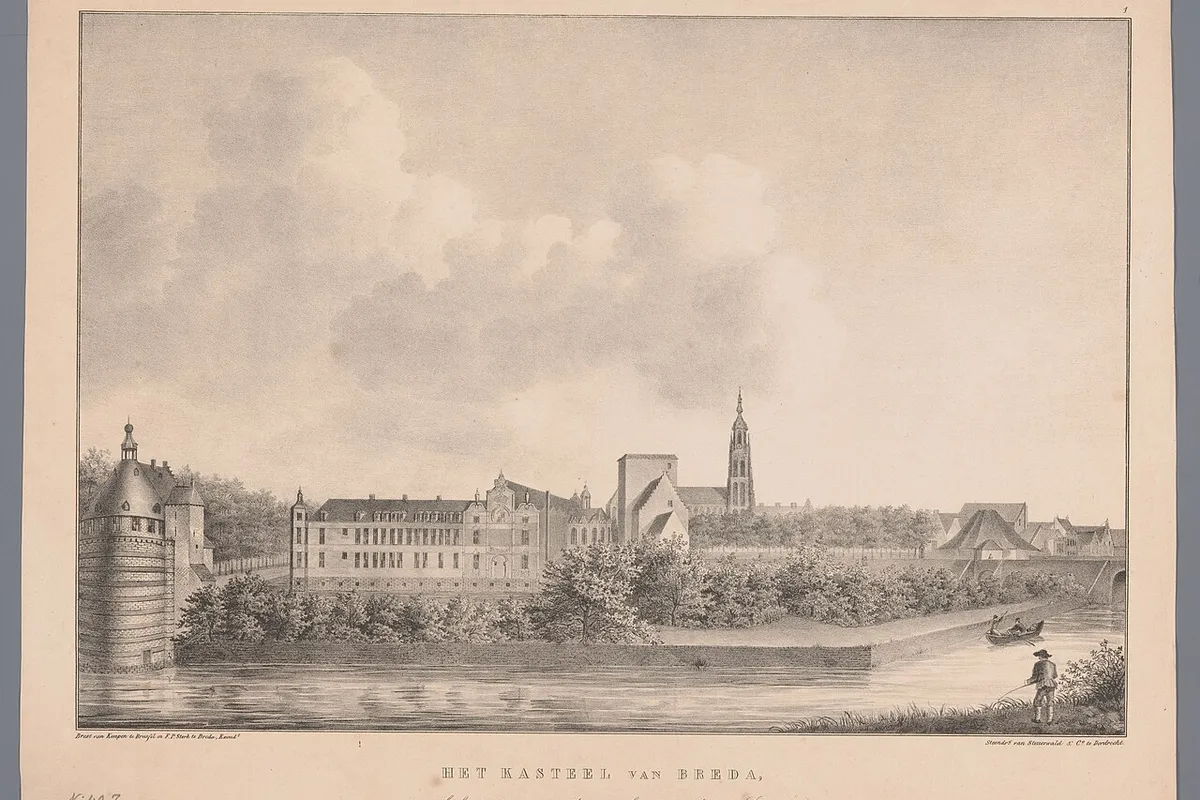 Photo: Breda, the Netherlands. Source: Wikimedia Commons.
- Population: 185,000 (city proper)
- Expat population: growing international community, particularly in logistics, tech, and academic sectors
- Main languages spoken: Dutch, English (widely spoken in logistics, digital, and university-connected sectors; most shops and employers comfortable in English)
- Key industries: logistics and distribution, creative and digital media, healthcare, cross-border trade with Belgium
- Average commute: 15–20 minutes by bike within the city; train to Rotterdam 25 minutes, Eindhoven 45 minutes, Amsterdam 70 minutes
Breda sits in the province of North Brabant, roughly halfway between Rotterdam and Eindhoven, about 10 kilometres north of the Belgian border. It is one of the larger Dutch cities outside the Randstad — large enough to feel like a real city, small enough that you start recognising faces after a few months.
What sets Breda apart is partly geography and partly character. The train connections are genuinely excellent for a city this size. The cost of living is noticeably lower than the Randstad. And the Brabant culture — unhurried, warm, sociable — makes it easier to settle than in many other Dutch cities. People are friendlier here. It sounds like a cliché until you experience it.
The city has also been quietly investing in itself. The Spoorzone district, a former railway yard just south of the station, has become a creative and cultural hub. The food scene has improved considerably. The historic centre — anchored by the Grote Markt and the Gothic Grote Kerk — has real character, not just tourist-brochure charm. Breda is not the loudest option for expats considering the Netherlands, but for a lot of people, it turns out to be the right one.
Cost of Living
Breda is significantly cheaper than Amsterdam, cheaper than Utrecht, and broadly comparable to Eindhoven — with an edge on value when you factor in the Brabant quality of life.
| Item | Estimated monthly cost |
|---|---|
| 1-bedroom apartment (private rental) | €850–€1,200 |
| 2-bedroom apartment | €1,200–€1,700 |
| Monthly OV public transport pass | €80–€130 (commuting frequency dependent) |
| Groceries (single person) | €380–€540/month (weekly shop for two: €95–€135) |
| Dinner out (mid-range, two people) | €56–€100 |
| Gym membership | €25–€45 |
Suburban areas like Princenhage and Teteringen tend to run €150–€300 cheaper than equivalent central properties. For comparison: a two-bedroom in central Amsterdam costs €2,200–€2,800. In Rotterdam, €1,600–€2,100. Breda sits comfortably below both.
Use the Housing Budget Checker to see what your budget covers in Breda before you start searching. The Cost of Living Calculator is also useful for building a full monthly picture.
Best Neighbourhoods for Expats
Centrum — The historic centre, anchored by the Grote Markt and the Grote Kerk. Walking distance from almost everything: restaurants, shops, the station, and most social life. The downside is noise on weekends and apartments that tend to be smaller and pricier. 1-bedroom rents average €1,000–€1,200. Works well for singles and couples who want to be in the middle of things.
Belcrum — Just north of the centre, between the old harbour and the ring road. The Belcrumhaven has been converted into a creative hub with restaurants, food markets, and event spaces. Slightly lower rents than Centrum, more interesting housing stock, and a younger, more creative crowd. I have been recommending this neighbourhood to clients more and more over the past few years. 1-bedroom average €950–€1,150.
Chassé Park — Built on the site of a former military barracks. Planned and orderly: wide streets, green space, modern architecture. Popular with young families and international residents, partly because of proximity to Breda University of Applied Sciences and several international employers. Newer build means better insulation and lower energy bills. Quieter than Centrum and Belcrum. 1-bedroom average €1,050–€1,300.
Ginneken — To the south of the centre, technically a separate village before Breda absorbed it, and it has kept that identity. The Ginnekenstraat is lined with independent shops, good restaurants, and cafés without the Grote Markt crowds. Quiet, leafy residential streets, older Dutch townhouses, and larger properties with gardens. This is where a lot of Breda’s established expat families end up. Rents are higher, but the space and character justify it for many. 1-bedroom average €1,100–€1,400.
Princenhage — Further west, a former village with a small market square and a genuinely suburban feel. Quieter and more affordable. Better suited to families than singles. Cycling to the city centre takes around 20 minutes. 1-bedroom average €850–€1,050.
For a full walkthrough of how to search for rental properties in the Netherlands, the Finding Housing guide covers the process from start to finish.
Working in Breda
Breda is not a single-industry city, which is both a strength and a limitation. It does not have the concentrated tech cluster that Eindhoven has around ASML and Philips, but the economic base is more varied.
Logistics and distribution is the biggest sector. Breda’s location — near the Belgian border, on multiple motorway junctions, with direct rail connections to Rotterdam and Antwerp — makes it a natural hub for warehousing, supply chain, and distribution. Amazon, DHL, and numerous other logistics companies have major operations in and around the city. English is sufficient for many roles in this sector.
Creative and digital has been growing, driven significantly by Breda University of Applied Sciences (BUAS, formerly NHTV). BUAS has strong programmes in games design, media, and hospitality, and draws international students and faculty. The Spoorzone district has become the centre of this community — small but active.
Healthcare is anchored by Amphia Hospital, one of the larger regional hospitals in North Brabant, and a significant local employer.
Cross-border work is worth mentioning. Some Breda residents commute to Antwerp or elsewhere in Belgium, taking advantage of lower Dutch housing costs. The 40-minute train journey to Antwerp makes this realistic.
For most professional roles, Dutch remains important for client-facing work and career progression. English gets you a long way, particularly in logistics and tech, but investing in Dutch language learning pays off if you plan to stay. Use the Salary Checker to benchmark compensation for your sector.
Coworking options include spaces in the Spoorzone district and a handful of shared office facilities in and around the centre. Not as extensive as Amsterdam or Rotterdam, but adequate for freelancers and remote workers.
Getting Registered
Registration is handled by Gemeente Breda. Appointments can be booked online at gemeente.breda.nl and tend to fill up a few weeks out, so do this as soon as you have a confirmed rental address.
Bring your valid passport (plus residence permit for non-EU citizens), your rental contract or a written declaration from your landlord, and any additional documents the municipality requests. Your BSN — the citizen service number that unlocks everything from your bank account to healthcare — is typically issued at or shortly after the appointment.
Non-EU citizens need to arrange their visa or residence permit through the IND (Immigratie en Naturalisatiedienst) before registering with the municipality. Do not leave this step until you arrive.
Without a BSN you cannot open a Dutch bank account, access healthcare properly, or start most jobs. It should be your first administrative priority. Use the BSN Planner to prepare your documents before the appointment — arriving with the wrong paperwork is a frustrating way to lose a few weeks.
Healthcare & Insurance
Amphia Hospital is the main hospital serving Breda and the surrounding region, and one of the larger general hospitals in North Brabant. It covers most specialties you would expect from a major regional hospital.
For general practice, English-speaking GPs are available, particularly in areas with higher concentrations of international residents. Finding a GP can take 2–4 weeks. Register as soon as you arrive — it is one of those things that feels less urgent than it is until you actually need a doctor.
Health insurance is mandatory from your first day as a Dutch resident, regardless of whether you are EU or non-EU. Premiums in 2026 run approximately €135–€160 per month, plus the annual deductible (eigen risico) of €385. Use the Health Insurance Wizard to compare policies before you commit.
If you are arriving from outside the EU and have a gap period before your Dutch insurance kicks in, consider interim travel or international health cover — SafetyWing is one option worth looking at for short-term gaps.
Transport
Breda’s train connections are genuinely one of the city’s strongest practical selling points. The station is on the main Amsterdam–Antwerp–Brussels axis, which means:
- Rotterdam Centraal: 25 minutes (direct)
- Eindhoven: 45 minutes (direct)
- Amsterdam Centraal: approximately 70 minutes (direct Intercity)
- Utrecht: approximately 55 minutes (direct)
- Antwerp: approximately 40 minutes (international service)
- Brussels: under 90 minutes
Schiphol Airport is reachable in under an hour by train — a significant advantage if you travel frequently for work. For day-to-day travel, get a personal OV-chipkaart rather than buying paper tickets. It is cheaper and more convenient. Full guidance is in the OV-chipkaart guide for expats.
Within the city, cycling is the default mode of transport, as it is everywhere in the Netherlands. Breda has good cycling infrastructure and most of the city is accessible by dedicated cycle paths. A decent second-hand bike runs €150–€350. Arriva operates the urban bus network — adequate but, as with most Dutch cities, cycling is almost always faster for local journeys.
If you drive, Breda is well connected: the A16 runs south to Antwerp and north to Rotterdam; the A27 connects north to Utrecht. Parking in the centre is expensive at €2.50–€3.50 per hour. For everyday life within the city, a car is largely unnecessary.
Related Guides
- Moving to Breda: Complete Guide 2026 — the detailed guide covering housing, neighbourhoods, pros and cons, and more
- Finding Housing in the Netherlands
- Working in the Netherlands
- Health Insurance for Expats
- Registering as an Expat in the Netherlands
- Other cities to compare: Rotterdam, Eindhoven, Den Bosch