Delft at a Glance
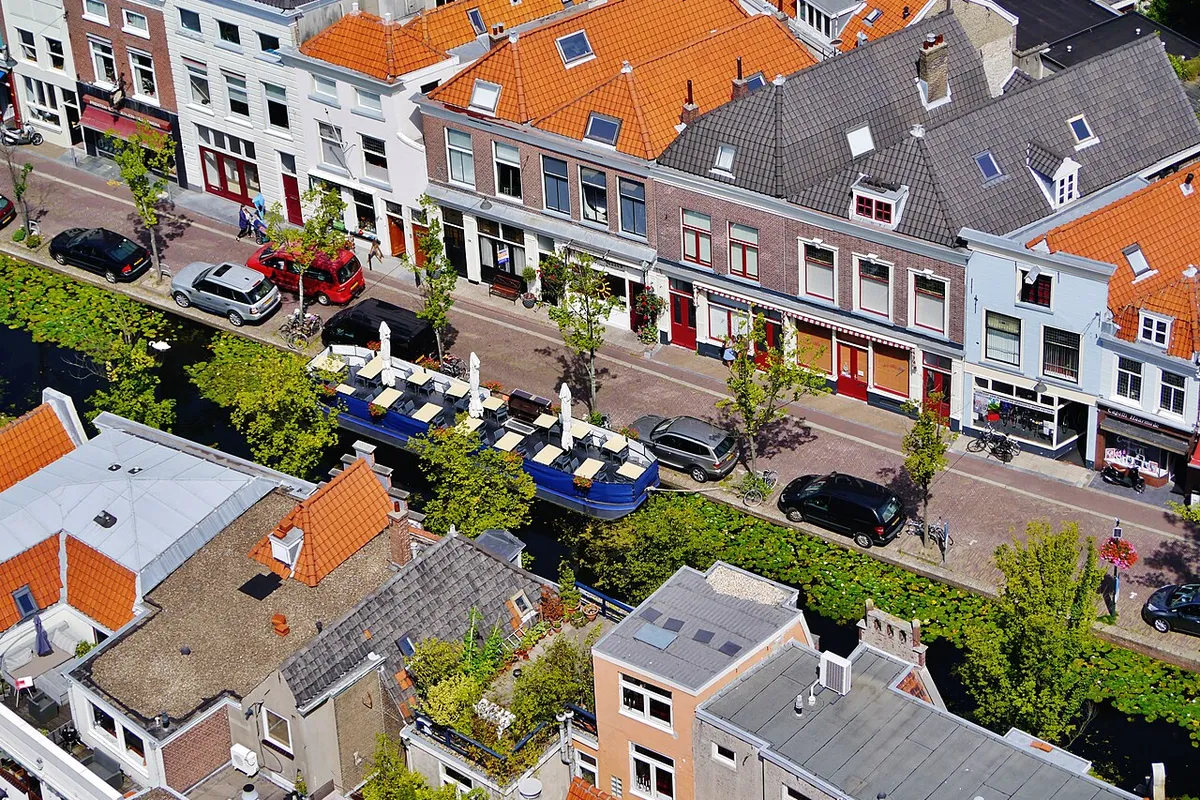 Photo: Delft, the Netherlands. Source: Wikimedia Commons.
- Population: 115,000 (city proper)
- Expat population: large — a significant share of TU Delft’s 27,000 students are international, plus thousands of international staff at TU Delft and TNO
- Main languages spoken: Dutch, English (very widely spoken; the university environment means you will rarely struggle to get by in English)
- Key industries: engineering research and education, applied scientific research, tech startups, government (proximity to The Hague)
- Average commute: 10–20 minutes by bike within the city; train to Rotterdam 12 minutes, The Hague 15 minutes, Amsterdam 55 minutes
Delft is a city of about 115,000 people in South Holland, sitting between Rotterdam and The Hague. It is best known internationally for Delft Blue pottery and Vermeer, but the people who actually move here come for TU Delft, one of the top engineering universities in Europe. The combination of a genuinely beautiful historic centre, fast train connections to two major cities, and a large international community makes it one of the more appealing mid-sized options in the Randstad.
The city is not for everyone. If you want Amsterdam’s scale of cultural life and nightlife, Delft is too small. If you want Rotterdam’s raw energy, it feels too quiet. But for academics, engineers, researchers, and the partners who follow them, Delft has a way of making itself feel exactly right.
I first visited Delft on a grey Tuesday in November, and the city surprised me — I had grown up hearing about the pottery and the paintings and expected something more self-consciously touristy. What I found was a city that gets on with itself quietly and confidently. Since then I have helped dozens of expats relocate here, mostly academics and engineers joining TU Delft or TNO, and this guide is what I tell every one of them before they arrive. For the full picture, the Moving to Delft guide goes deeper on every aspect of the relocation.
Cost of Living
Delft is meaningfully cheaper than Amsterdam — roughly 25–35% less on rent — and somewhat cheaper than Rotterdam or The Hague. It is not cheap in absolute terms, but for a city with this much going for it, the value is good.
| Item | Estimated monthly cost |
|---|---|
| 1-bedroom apartment (city centre) | €1,050–€1,350 |
| 1-bedroom apartment (outer areas) | €800–€1,000 |
| 2-bedroom apartment | €1,400–€1,800 |
| Monthly OV public transport pass | €90–€130 |
| Groceries (single person) | €250–€350 |
| Dinner out (mid-range, two people) | €50–€75 |
| Gym membership | €25–€50 |
Furnished units add roughly €100–200 per month. Utilities for a one-bedroom typically run €100–180 per month depending on the building’s energy rating — the older canal houses in the Binnenstad look beautiful but can have heating bills to match.
Use the Housing Budget Checker to work out what your budget actually covers once you factor in Dutch income tax, health insurance, and other fixed costs. The Cost of Living Calculator lets you compare Delft directly against other Dutch cities.
Best Neighbourhoods for Expats
Binnenstad (City Centre) — The historic centre with canal houses, the Nieuwe Kerk, the Markt square, and cobblestone streets. Rent averages €1,050–€1,350 for a one-bedroom. This is the most attractive place to live in Delft — you cycle to the train station in five minutes and walk to every supermarket and restaurant. The downside: apartments are often on upper floors accessed by steep Dutch stairs, insulation in older buildings is poor, and parking is essentially impossible. Best for single professionals, academics, and couples without children who want to walk everywhere.
Voorhof — West of the train line, about 15 minutes’ cycle from the Binnenstad. The most affordable neighbourhood within reasonable distance of the centre: one-bedroom average €800–€1,050. It has a working-class, multicultural character and is slowly gentrifying. The area around Brasserskade has a good range of everyday shops. Not as polished as the Binnenstad — some people love the community feel, others find it rougher than they expected. Best for budget-conscious expats or families who need more square metres per euro.
Tanthof — A planned residential neighbourhood in the south of the city, built mostly in the 1970s and 80s. Quiet, green, and dominated by family homes and apartments with gardens or balconies. Rent is among the lowest in Delft and apartments tend to be larger: one-bedroom average €800–€1,000. There is almost no nightlife or restaurant scene, but good schools, cycle paths, and a tram connection to the centre. Best for families, people working from home, and those who prioritise space and quiet.
Vrijenban — East of the train station, bordering Rotterdam. Rent slightly below the Binnenstad, with more modern apartment stock. The area has improved over the past decade, partly driven by the rebuilt Delft Centraal station. Commuters heading to Rotterdam will appreciate the direct station access. Best for people who want modern apartments at mid-range prices and an easy commute south.
TU Delft Campus Area (Wippolder / Zuid) — The area directly adjacent to TU Delft has the highest concentration of international students and early-career researchers, with a lot of student housing through DUWO (TU Delft’s own housing service) and private landlords. One-bedroom average €900–€1,150. The advantage is proximity to campus and an instant social network. The disadvantage is that it can feel like a bubble. Best for TU Delft students, PhD candidates, and postdocs in their first year.
Working in Delft
TU Delft is the dominant employer and has shaped the entire character of the city. It has faculties covering civil engineering, aerospace, electrical engineering, industrial design, architecture, and applied sciences, employing over 5,000 staff — a significant proportion of them international. The working language in most research groups is English. If you have been hired by TU Delft, the university’s HR and international office will guide you through the initial bureaucracy.
TNO (Netherlands Organisation for Applied Scientific Research) occupies a large campus adjacent to TU Delft and employs several thousand people nationally. Its Delft operations work across energy, ICT, defence, and materials — closely linked to TU Delft research. TNO has a substantial international workforce and actively recruits internationally.
The ecosystem around TU Delft has also produced a significant number of startups and scale-ups through the YES!Delft incubator, covering robotics, cleantech, medical technology, and software. If you are a founder or early-stage employee in the deep-tech space, Delft’s network punches well above the city’s size.
Many expats in Delft work in Rotterdam or The Hague and commute. The 12–15 minute train journey makes this entirely practical — it is a more manageable commute than many London or Paris workers put up with. A monthly NS season ticket for one of these corridors runs €90–130.
Use the Salary Checker to benchmark your compensation against Dutch market rates.
Getting Registered
If Delft is your primary residence, you must register with Gemeente Delft within five days of moving in. This gives you your BSN (Burgerservicenummer), your Dutch citizen service number — without it, you cannot open a bank account, get Dutch health insurance, or legally receive a salary.
Book your appointment online at gemeente.delft.nl — go to “Producten en diensten” and search for “Eerste inschrijving BRP”. As of early 2026 you can typically get a slot within two to three weeks. Bring your passport (or EU identity card), proof of address in Delft (rental contract or a signed declaration from your landlord), and for non-EU citizens, your valid residence permit or proof of permit application. The appointment takes about 20 minutes and staff speak English.
Your BSN is issued on the spot or arrives by letter within a few days. From there: open a Dutch bank account, register with a huisarts (GP) within the first week, and take out Dutch health insurance within four months of arrival (or immediately if arriving from outside the EU).
The BSN Planner walks through this sequence and helps you track which steps you have completed.
Healthcare & Insurance
The main hospital serving Delft is Reinier de Graaf Gasthuis, a general teaching hospital located in Delft with English-speaking staff. For specialist or emergency care you may be referred to Erasmus MC in Rotterdam, one of the leading academic medical centres in Europe and just 12 minutes by train.
For day-to-day care, the huisarts (GP) is your entry point into the system — you need to be registered with one before you can get a referral to a specialist or a prescription renewed. Register as soon as you move in, not when you are already ill. Many practices in Delft have limited spots for new patients and some are currently closed to new registrations. The website Zorgkaart Nederland lists Delft GPs with ratings and information on whether they are accepting new patients.
Health insurance is mandatory from your first day as a Dutch resident. Budget €130–160 per month for a standard policy, with a €385 annual deductible. Use the Health Insurance Wizard to compare policies and find the right fit.
Transport
Delft has two train stations: Delft Centraal (the main one, rebuilt and modernised in 2015) and Delft Zuid (useful primarily if you are on the TU Delft campus or living in Tanthof or Buitenhof).
Key journey times from Delft Centraal:
| Destination | Journey time | Frequency |
|---|---|---|
| Rotterdam Centraal | 12 minutes | Every 15 minutes |
| Den Haag Centraal | 15 minutes | Every 15 minutes |
| Amsterdam Centraal | 55 minutes | Every 30 minutes (direct Intercity) |
| Utrecht Centraal | 50 minutes | Every 30 minutes |
| Schiphol Airport | 65–75 minutes | Every 30 minutes |
The train connections are one of Delft’s most significant practical advantages. Many residents work in Rotterdam or The Hague and commute daily — 12 to 15 minutes is genuinely short, and trains run every 15 minutes in both directions.
Cycling is not just an option in Delft — it is how the city actually functions. There are well-maintained cycle lanes throughout, dedicated bike parking at the station, and the culture treats cycling as the default for any journey under 5 km. I would not recommend living in Delft without a bike. A decent second-hand bike costs €100–200; new quality bikes (Batavus, Gazelle) start around €500.
HTM operates bus and tram routes connecting Delft with The Hague, and local bus lines cover the city neighbourhoods. The OV-chipkaart is your payment method for all public transport. See the OV-chipkaart guide for expats for how to get one set up.
Related Guides
- Moving to Delft: Complete Guide 2026 — detailed guide covering housing search, daily life, pros and cons
- Finding Housing in the Netherlands — how the rental market works, documents, scam warnings
- Working in the Netherlands — employment contracts, tax, 30% ruling
- Health Insurance for Expats — what you must have, what to add
- Registering as an Expat in the Netherlands — BSN, DigiD, gemeente process
- Nearby: The Hague — 15 minutes by train, international organisations, embassies
- Nearby: Rotterdam — 12 minutes by train, port, architecture, lower rents
- Nearby: Leiden — 20 minutes north, university city, biotech