In this guide
Delft at a Glance
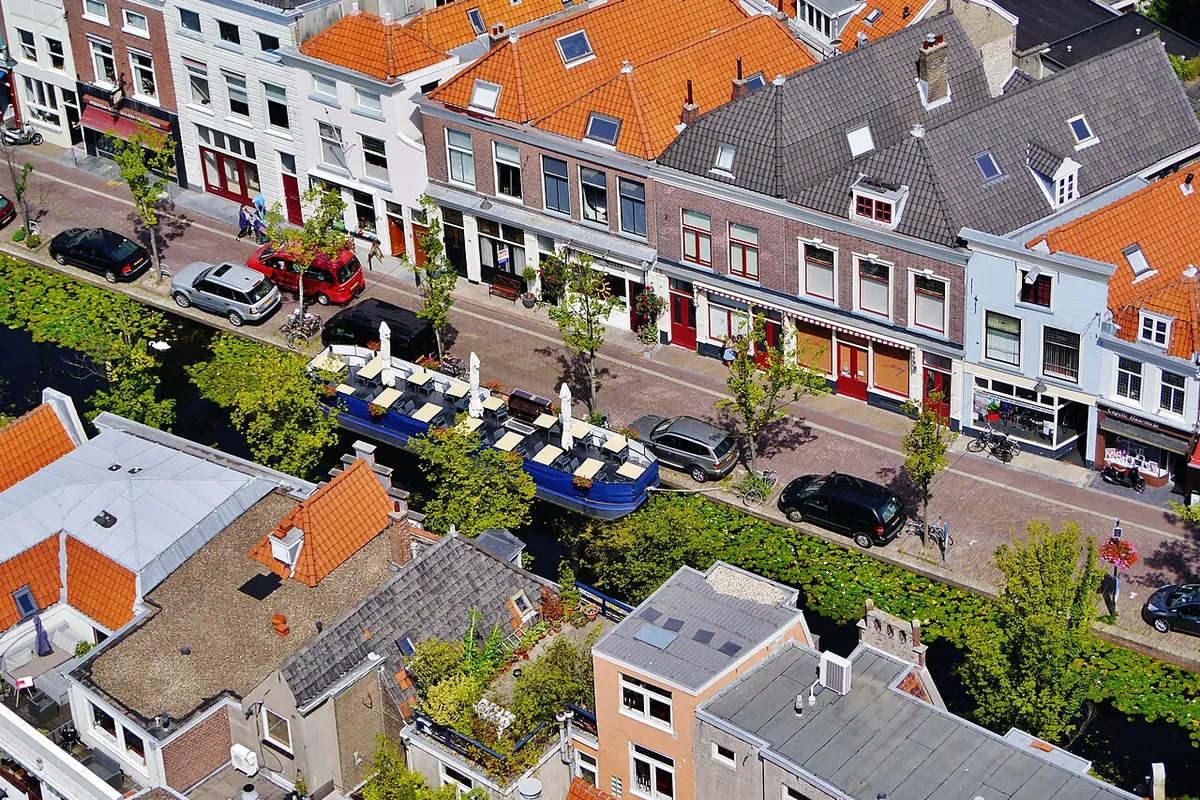
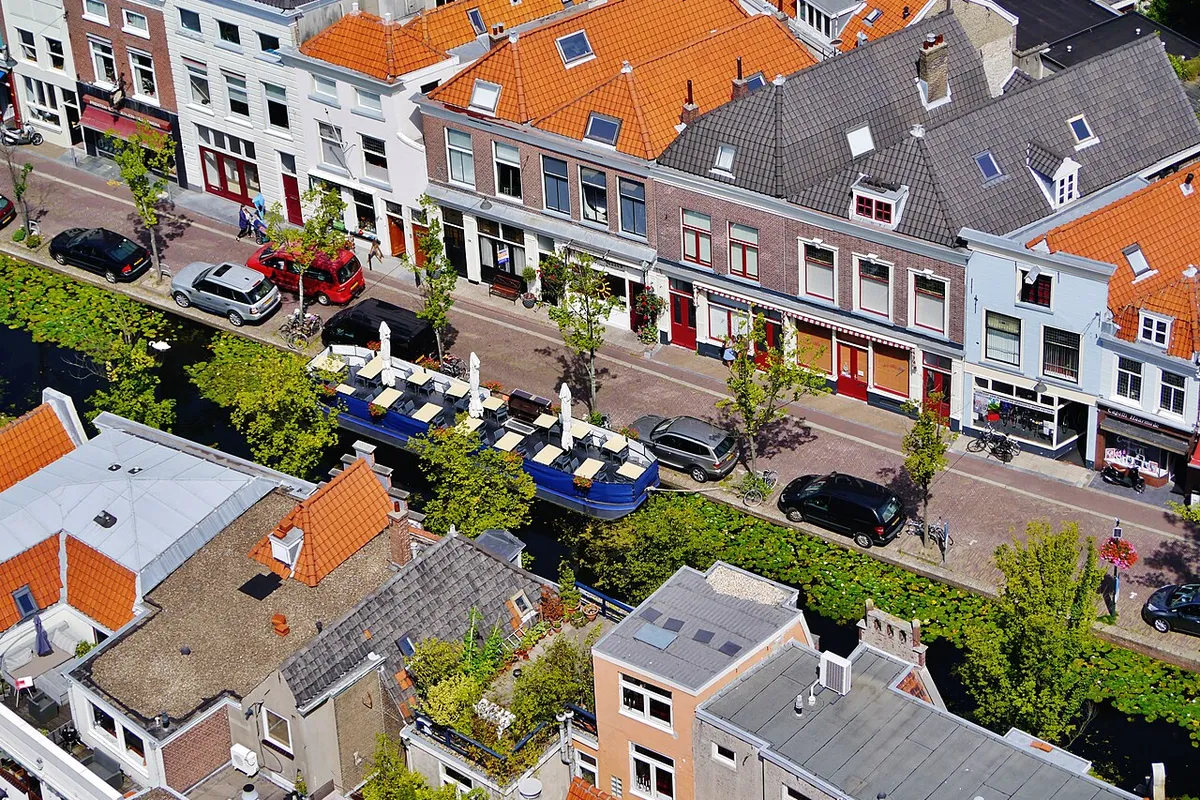 Photo: Delft, the Netherlands. Source: Wikimedia Commons.
- Population: 109,408 (municipality; Statistics Netherlands, end of August 2026)
- Known for: TU Delft, TNO and the YES!Delft incubator
- Main languages: Dutch; English is widely used in the university and research environment, but check requirements per employer or service
- Location: between Rotterdam and The Hague; check journey times on the NS journey planner (ns.nl)
Cost of Living
We do not publish rent tables or average living costs for Delft. Rents differ by building, area, furnished or unfurnished contract and year, and we have no official source for a single set of figures. Compare live listings on Funda, Pararius and Kamernet, and use the Housing Budget Checker and Cost of Living Calculator for your own situation.
A landlord may ask a deposit (waarborgsom) of at most 2 months of base rent for contracts signed from 1 July 2023, and must repay it within 14 days after the end of the tenancy (Rijksoverheid).
Health insurance is the same national system everywhere: the average basic premium in 2026 is €157 per month, and the statutory deductible (eigen risico) is €385 a year. Every basic policy covers the same statutory care by law, so price and service are the variables.
Local charges: the one cost that is city-specific
A tenant in Delft receives annual bills from Gemeente Delft and from the water authority, Hoogheemraadschap van Delfland.
| Charge (2026) | Single | Multi-person household | Ordinance |
|---|---|---|---|
| Afvalstoffenheffing (waste levy) | €283.59 | €444.25 | Verordening reinigingsheffingen 2026, tarieventabel 1.1 |
| Rioolheffing, owner portion | €209.98 | €209.98 | Delft rioolheffing ordinance 2026 |
| Rioolheffing, user portion | €58.92 for the first full 500 m3 unit of water | €58.92 for the first full 500 m3 unit of water | same ordinance |
| Watersysteemheffing, residents (per home) | €137.51 | €137.51 | Delfland watersysteemheffing 2026 |
| Zuiveringsheffing (€115.33 per pollution unit) | 1 unit: €115.33 | 3 units: €345.99 | Delfland zuiveringsheffing 2026 |
How the rules work, according to the ordinances:
- Waste levy: Delft has two bands, one-person household and multi-person household. It is charged to the household using the property.
- Sewerage charge: it has an owner portion (€209.98) and a user portion of €58.92 for the first full unit of 500 m3 of water. How the user portion applies to your home is for your assessment to show, so check the assessment you receive rather than assuming either way. We do not include it in the totals below.
- Pollution units: under the Delfland rule, a home used by one person counts as 1 pollution unit and a home used by more than one person as 3. That is why the zuiveringsheffing for a multi-person household is three times that of a single person (3 x €115.33 = €345.99).
Adding up the waste levy, the watersysteemheffing and the zuiveringsheffing (excluding the sewerage charge):
| Household | Per year | Per month |
|---|---|---|
| Single | 283.59 + 137.51 + 115.33 = €536.43 | €44.70 |
| Multi-person | 444.25 + 137.51 + 345.99 = €927.75 | €77.31 |
Both bills can be objected to, and low-income households may apply for remission (kwijtschelding). Tariffs are reset every year: these are the 2026 rates from each body’s own ordinance (lokaleregelgeving.overheid.nl, checked 6 October 2026). Check your own assessment.
Neighbourhoods
Delft’s main areas include the Binnenstad (the historic city centre with the Nieuwe Kerk and the Markt), Voorhof, Tanthof, Vrijenban and the area around the TU Delft campus. We do not describe their character or rents, because those differ by street and change over time. Visit the area and the specific property more than once, at different times of day. Many Binnenstad buildings are old, so check the energy label and the floor level and stairs before you commit.
Working in Delft
TU Delft is a large employer in the city. If you are hired there, the university’s HR and international office can explain the initial steps. TNO is a Dutch research organisation that bridges academic research and industrial application, and has a location in Delft. YES!Delft is an incubator and accelerator that says it has supported more than 600 startups (yesdelft.com).
Many people live in Delft and work in Rotterdam or The Hague. Check journey times and NS subscription prices on ns.nl for your route.
Use the Salary Checker to benchmark your compensation, the 30% Ruling Calculator to see how much tax you could save, and the Diploma Evaluator if you have a foreign degree.
Getting Registered
If you will stay in the Netherlands for more than 4 months, register with Gemeente Delft within 5 days of arriving (RvIG). Registration leads to your BSN (Burgerservicenummer), which you need to open a bank account, take out health insurance and receive a salary. Book an appointment through the municipality’s website (delft.nl) and check there what to bring. Usually that is a valid passport or ID card, proof of your address, and for non-EU citizens a residence permit.
From there: open a Dutch bank account, register with a huisarts (GP), and take out Dutch health insurance within 4 months of arrival.
Not sure which visa you need? Use the Visa Checker. The BSN Planner walks through this sequence, and the Inburgering Route Planner shows civic integration requirements.
Healthcare & Insurance
Reinier de Graaf is a hospital in Delft that describes itself as a top clinical hospital (topklinisch ziekenhuis, STZ) (reinierdegraaf.nl). For some specialist care you may be referred to a hospital in a neighbouring city.
The huisarts (GP) is your entry point into the system, and you generally need to be registered with one to be referred to a specialist. Register as soon as you move in. Some practices have a limited number of places for new patients; Zorgkaart Nederland lists GPs and shows whether they are accepting new patients.
Dutch health insurance is mandatory: take it out no later than 4 months after arriving, with cover from the day you arrive (government.nl). Use the Health Insurance Wizard to compare policies and the Insurance Comparison for expat insurance options.
Transport
Delft has railway stations, and the connections to Rotterdam and The Hague are a reason many people live there. Check journey times and frequencies on ns.nl. HTM runs bus and tram routes between Delft and The Hague, and the OV-chipkaart is the payment method for public transport; see the OV-chipkaart guide. See also Rotterdam and The Hague.
Getting Started in Delft
Arrange payment details: a Dutch bank account is convenient for local payments, but a landlord or company may not refuse a euro IBAN from another EU/EEA country (De Nederlandsche Bank). Wise gives verified customers EUR account details with a non-Dutch euro IBAN (Wise uses a Belgian BIC and address). Try Wise Use the Bank Account Comparison to find a Dutch bank.
Get health insurance: the basic package is the same at every insurer, so compare premium, policy type and supplementary cover with the Health Insurance Wizard.
Consider expat insurance: if you are still settling in or working remotely, you can compare policies such as SafetyWing, which lists USD 62.72 per 4 weeks for ages 18 to 39 (safetywing.com, checked 5 October 2026). A travel policy does not replace Dutch basic insurance once you live here. See SafetyWing
Plan your budget: use the cost of living calculator and housing budget checker.
Schools and Families
Check which schools in the Delft area suit your child and language needs, and apply early, because rules and places differ per school. For international options in the region, compare schools in The Hague and Rotterdam directly. See our school guide for expat children.
Housing Search: Practical Advice
Funda and Pararius are the main platforms; Kamernet is for rooms. DUWO is a student housing provider with rooms in Delft and other cities (duwo.nl); check its registration rules if you are a student. When an agency offers you a home on the landlord’s behalf, it may not charge you a finder’s fee (Rijksoverheid). See finding housing in the Netherlands and the Moving to Delft guide.
Settling In: The First Month
- Finalise housing, with the landlord’s permission to register at the address.
- Book your registration at Gemeente Delft.
- Attend the appointment and receive your BSN.
- Open a Dutch bank account.
- Take out health insurance.
- Register with a GP.
- Apply for DigiD after receiving your BSN.
Frequently Asked Questions
How much is the waste levy in Delft in 2026?
€283.59 a year for a one-person household and €444.25 for a multi-person household, under the Verordening reinigingsheffingen 2026, tarieventabel 1.1. It is charged to the household using the property. Low-income households can apply to the municipality for remission (kwijtschelding).
Do tenants pay the sewerage charge in Delft?
Delft’s rioolheffing has an owner portion of €209.98 and a user portion of €58.92 for the first full unit of 500 m3 of water. How the user portion applies to your home is shown on your own assessment, so read it rather than assuming either way.
What is the water authority bill in Delft?
Delft falls under Hoogheemraadschap van Delfland. In 2026 the watersysteemheffing for residents is €137.51 per home and the zuiveringsheffing is €115.33 per pollution unit: 1 unit for a one-person home, 3 units for a home used by more than one person.
How many people live in Delft?
109,408 at the end of August 2026 (Statistics Netherlands).