In this guide
Groningen at a Glance
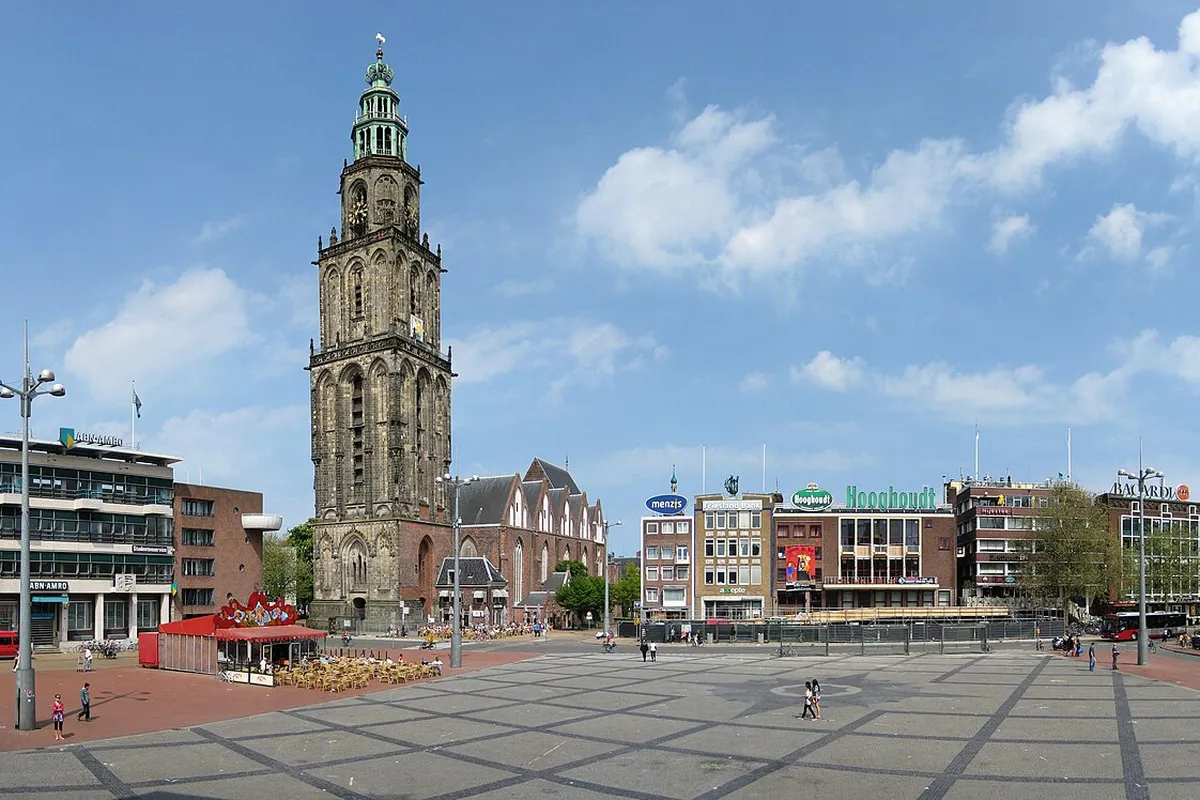 Photo: Groningen, the Netherlands. Source: Wikimedia Commons.
- Population: 241,388 (municipality; Statistics Netherlands, July 2026)
- Expat population: approximately 25,000 — around 11% of residents, a significant proportion given the city’s size
- Main languages spoken: Dutch, English (well-spoken across the population, especially given the large student and academic community; Gronings dialect also present among long-term residents)
- Key industries: energy (including a major transition away from natural gas), higher education (University of Groningen, Hanze University), healthcare (UMCG)
- Average commute: 15–25 minutes by bike; the city is genuinely compact
Groningen is the largest city in the northern Netherlands and one of the most affordable in the country. It is also one of the youngest cities in the Netherlands demographically — with around 60,000 students in a city of 241,388 (municipality; Statistics Netherlands, July 2026), it has a different energy to the Randstad cities.
The energy sector has been central to Groningen’s recent history in ways that are impossible to ignore. The Groningen gas field, once Europe’s largest, caused significant earthquake damage to homes across the province through decades of extraction. The field was effectively closed in 2023, but the aftermath — structural damage, government compensation claims, reconstruction — is still working through the system. The government has committed to a substantial energy transition investment programme in the region, which is creating jobs in renewable energy, grid infrastructure, and related engineering.
If you are coming for the University of Groningen (RUG) — ranked consistently in the top 100 globally — the city is an excellent place to be. If you are coming for industry, the energy sector and UMCG (the university medical centre, one of the largest in the Netherlands) are the main anchors.
Cost of Living
Groningen is the most affordable city covered on this site for renters, and the gap with the Randstad is not marginal. On base rent, a one-bedroom here comes out around 42% cheaper than the Amsterdam equivalent, and a two-bedroom also around 42% cheaper. In practical terms a single person’s modelled monthly total is roughly €700 lower than in Amsterdam — which for anyone whose work does not require a Randstad address is the whole argument for the city in one number.
The honest caveat is that the saving is overwhelmingly a rent saving, and the rent figure is the least precise number on this page. What follows is separated into three layers for exactly that reason. Rent is an editorial market indication, not a measured average. The national fixed costs — health insurance, groceries, utilities, internet, transport — are effectively identical wherever in the Netherlands you live, because they are national markets with the same insurers, supermarkets and NS fares. The only genuinely city-specific numbers that can be verified line by line are the municipal charges and the regional water authority charges, both set out in published tax ordinances.
Groningen’s local charges sit in the middle of the national range, not at the bottom. Cheap rent does not automatically mean cheap gemeente bills, and Noorderzijlvest’s zuiveringsheffing is on the higher side.
Rent (base rent, editorial market indication)
| Item | Estimated monthly cost |
|---|---|
| 1-bedroom apartment (private rental) | €850–€1,050 |
| 2-bedroom apartment | €1,150–€1,400 |
| Monthly OV public transport pass | €98–€120 |
| Groceries (single person) | €250–€340 |
| Dinner out (mid-range, two people) | €45–€65 |
| Gym membership | €20–€40 |
Editorial market indication for private-sector rentals, ExpatNetherlandsHub, August 2026 — base rent excluding servicekosten and utilities. Individual listings vary widely by neighbourhood, energy label and furnishing.
The student market dominates the rental sector in the city centre and inner neighbourhoods, which can make finding appropriate accommodation for professionals tricky. Competition for non-student apartments is real but manageable compared to Amsterdam.
That student dominance is also why the room-and-studio market matters more here than in most Dutch cities. With around 60,000 students in a city of 241,388, a very large share of Groningen’s available stock is rooms and studios rather than self-contained flats, and it is advertised on room platforms rather than on Funda or Pararius. If you are arriving alone, or arriving before a long lease is signed, this is genuinely the right place to look rather than a fallback — though check the listing terms, because a significant amount of central stock is student-designated and not available for non-student registration.
Disclosure: the link below is an affiliate link. If you sign up we may earn a commission, at no extra cost to you — see how we earn.
Search rooms and studios on Kamernet →
The costs that are the same in every Dutch city
These ranges come from this site’s own Cost of Living in the Netherlands 2026 guide and apply nationally — they are not adjusted for Groningen, because in practice they do not vary by city.
| Component | Single | Couple | Family (2 adults + 2 children) |
|---|---|---|---|
| Health insurance (basic policy, per adult) | €157 | €314 | €314 (children under 18 free) |
| Groceries | €250–€350 | €400–€550 | €600–€850 |
| Utilities (gas, electricity, water) | €150–€250 | €180–€280 | €220–€350 |
| Internet + mobile | €50–€80 | €70–€110 | €80–€130 |
| Transport (OV + bike) | €100–€200 | €150–€300 | €200–€400 |
The totals further down use the midpoints of those ranges:
- Single: €872/month = 157 + 300 + 200 + 65 + 150
- Couple: €1,334/month = 314 + 475 + 230 + 90 + 225
- Family: €1,729/month = 314 + 725 + 285 + 105 + 300
On health insurance: in 2026 the average basic policy costs about €157 per month (Rijksoverheid), and the statutory deductible (eigen risico) is €385 per year. Cover is mandatory from your first day of residency, and because the basic package is fixed by law the only real variables are price and service.
Local charges: the one number that really is city-specific
Two separate annual bills reach a tenant in Groningen: one from the gemeente, one from Waterschap Noorderzijlvest. They are distinct bills and do not arrive together.
| Charge 2026 | 1 person | 2 persons | 3 persons | 4+ persons | Ordinance |
|---|---|---|---|---|---|
| Afvalstoffenheffing (waste levy) | €283.08 | €331.20 | €402.12 | €402.12 | Verordening afvalstoffenheffing 2026, tarieventabel 1 |
| Rioolheffing — owner | €178.69 | €178.69 | €178.69 | €178.69 | Verordening rioolheffing Groningen 2026 |
| Rioolheffing — tenant | €0 | €0 | €0 | €0 | as above |
| Watersysteemheffing ingezetenen (Noorderzijlvest) | €129.11 | €129.11 | €129.11 | €129.11 | Belastingverordening watersysteemheffing Noorderzijlvest 2026 |
| Zuiveringsheffing (Noorderzijlvest, €106.27 per v.e.) | €106.27 | €318.81 | €318.81 | €318.81 | Belastingverordening zuiveringsheffing Noorderzijlvest 2026 |
The waste levy is the tenant’s bill: €283.08 for one person, €331.20 for two, and €402.12 for three or more, with no further step above three. It is charged to the household using the property, so a tenant pays it directly.
The sewerage charge is where expats routinely budget for a bill they will never receive. In Groningen the rioolheffing is levied on the property owner only, at €178.69 for 2026. As a tenant you pay €0 — the landlord pays it, and unlike some cities there is not even a user portion for a household to worry about. It is worth saying plainly, because the assumption that a tenant owes roughly €180 a year here is common and simply wrong.
The waterschap bill is separate from the gemeente bill, and a tenant pays both of its parts. The watersysteemheffing ingezetenen (€129.11) is a flat charge per home. The zuiveringsheffing is charged per pollution unit — “vervuilingseenheid”, v.e. — and the statutory rule is blunt: one occupant counts as 1 v.e., more than one occupant counts as 3 v.e., however many more there are. That is why the jump from single to couple is so steep. In Groningen €106.27 becomes €318.81 the moment a second person registers at the address, and it does not rise again for a third or a fourth. For a couple, the water authority bill alone is larger than the gemeente waste bill.
The variation between water authorities is striking. Noorderzijlvest charges €106.27 per pollution unit; the Hoogheemraadschap van Delfland charges The Hague residents €115.33, while Waterschap De Dommel charges Eindhoven residents only €78.48. Eindhoven’s watersysteemheffing of €66.60 is the lowest of the ten cities on this site and Delfland’s Hague bill is among the highest. The same two statutory charges under the same national law produce very different money, depending on what each authority’s water system costs to maintain.
Combined, what a tenant in Groningen actually pays:
| Household | Per year | Per month |
|---|---|---|
| Single | €518.46 | €43 |
| Couple | €779.12 | €65 |
| Family of four | €850.04 | €71 |
If an assessment looks wrong, or remission (kwijtschelding) might apply, use Groningen’s current assessment page for the procedure. Our cost-of-living guide puts local charges in budget context.
Monthly total by household profile
| Profile | Rent | National fixed costs | Local charges | Total |
|---|---|---|---|---|
| Single, 1-bedroom | €950 | €872 | €43 | €1,865 |
| Couple, 1-bedroom | €950 | €1,334 | €65 | €2,349 |
| Family of four, 2-bedroom | €1,275 | €1,729 | €71 | €3,075 |
The arithmetic, so you can re-add it: 950 + 872 + 43 = €1,865; 950 + 1,334 + 65 = €2,349; 1,275 + 1,729 + 71 = €3,075. Rent uses the midpoint of the indicative bands above.
What these totals exclude, and you should plan for separately: income tax and any effect of the 30% ruling; one-off setup costs, meaning the deposit, furnishing an unfurnished Dutch rental and any agency fee; childcare; international school fees; and a car. One Groningen-specific point on that last item: the distance from the Randstad means regular train travel south is a real recurring cost for some people, and it is not in the transport line above.
Municipal and water authority tariffs above are the 2026 rates as adopted in each body’s own tax ordinance, retrieved from lokaleregelgeving.overheid.nl on 21 August 2026. Rent figures are an editorial market indication, not a measured average. Local rates are reset every year — check your own assessment.
Run the numbers for your own situation with the Housing Budget Checker, the Cost of Living Calculator, the Salary Checker and the 30% Ruling Calculator. For the practical side of getting into a property, see Moving to Groningen: Complete Expat Guide 2026 and finding housing in the Netherlands.
Best Neighbourhoods for Expats
Centrum — The city centre is compact, walkable, and genuinely pleasant. The Grote Markt (main square) is the focal point. A good mix of apartments above shops and purpose-built residential buildings. 1-bedroom rents average €950–€1,150. Expect some student noise in certain streets.
Paddepoel — A residential neighbourhood in the north of the city, with good access to the university’s northern campus. Popular with academic staff and researchers. 1-bedroom average €850–€1,000.
Helpman — One of the quieter, more established residential areas in the south of the city. Green, with good schools and a slightly older demographic mix. 1-bedroom average €900–€1,050. Popular with families working at UMCG, which is nearby.
Selwerd — North-west of the centre, a mixed neighbourhood with affordable housing and reasonable connectivity. Less commonly chosen by new international arrivals but worth considering if budget is a priority. 1-bedroom average €800–€950.
Working in Groningen
The University of Groningen is a major employer directly (academic and support staff) and indirectly through the research and startup ecosystem around it. International academic hiring is substantial — if you are a researcher or academic, Groningen is one of the better Dutch cities for your sector. The university’s Zernike Campus in the north of the city houses a range of science and technology faculties and research institutes.
UMCG (University Medical Centre Groningen) employs around 13,000 people and is one of the largest employers in the north of the Netherlands. Healthcare and medical research roles are well represented.
The energy transition is creating new employment. The regional government and national programmes have committed billions in investment for hydrogen infrastructure, solar, and offshore wind operations in the northern provinces. Groningen Seaports (Delfzijl and Eemshaven) are central to this — several large industrial companies including Google (data centre), Amazon (data centre), and Nouryon operate in the Eemshaven area.
Coworking options in the city include The Birdhouse, and the university’s StartHub Groningen for entrepreneurial ventures. Day passes from €15; monthly memberships from €150.
For salary benchmarking use the Salary Checker. Use the 30% Ruling Calculator to see how much tax you could save. If you have a foreign degree, check recognition requirements with the Diploma Evaluator. See also Working in the Netherlands.
Getting Registered
Registration is handled by Gemeente Groningen. Appointments at the Stadhuis or district offices can be booked online. Waiting times are typically 1–2 weeks — notably shorter than in the Randstad cities.
The university operates an International Welcome programme for incoming academic staff and researchers that includes registration support — if you are arriving through RUG, contact them before you arrive.
Standard documentation: passport, rental contract, employment contract or proof of sufficient funds. BSN issued on registration day.
Not sure which visa you need? Use the Visa Checker to find out. Use the BSN Planner to prepare your documents before your appointment. Planning your integration path? Use the Inburgering Route Planner to see your requirements.
Healthcare & Insurance
UMCG is the main hospital and one of the largest in the Netherlands. For general practice, a number of English-speaking GP practices operate in the city, particularly in areas popular with international students and staff. Waiting times for registration are typically 1–3 weeks.
Dutch health insurance is mandatory: take it out as soon as you can and no later than 4 months after arriving, with cover from the day you arrived (Government.nl). The average basic premium in 2026 is €157/month (Rijksoverheid), with a €385 annual deductible. Use the Health Insurance Wizard to compare policies. Compare Dutch and international expat insurance options with the Insurance Comparison.
Transport
Groningen is possibly the most bicycle-centric city in the Netherlands — which, given the competition, is a meaningful claim. Historically, cycling modal share in the city centre has exceeded 60%. The urban area is compact enough that almost everything is reachable by bike within 15–20 minutes.
By train, Groningen connects to Amsterdam in around 2 hours 15 minutes (via Zwolle or Assen), Utrecht in 1 hour 45 minutes, and Leeuwarden in 50 minutes. The distance from the Randstad is the main practical disadvantage of the city — if you travel frequently to Amsterdam or Rotterdam for work, factor the journey time and costs in.
Groningen Airport Eelde handles a small number of routes but is primarily used for private aviation and flight training. Schiphol is the realistic departure point for most international travel.
For a full guide to OV travel in the Netherlands, see the OV-chipkaart guide for expats.
Practical Tips for Your First Weeks in Groningen
Buy a bike before you do anything else. The city functions on cycling to an unusual degree even by Dutch standards. Without a bike in Groningen, you are significantly less mobile than everyone around you. Second-hand bikes are available from the Fietsacademie (a social enterprise that repairs donated bikes), local Facebook groups, and the Saturday market.
The distance from the Randstad affects your social life in ways worth planning for. Amsterdam is over two hours by train. If your professional network, family, or friends are primarily there, budget for regular trips — the cost of monthly or bi-monthly train travel adds up. NS subscription options can reduce per-trip costs significantly for regular routes.
Groningen’s wind comes from the north. The city’s flat, open setting means weather arrives unobstructed. A quality rain jacket and waterproof cycling gear are practical investments from week one, not seasonal luxuries. The 30% ruling, if you qualify, is worth factoring into your first-year purchases.
The Gronings dialect is genuinely different from standard Dutch. Long-term residents and older Groningers often speak it among themselves. Most younger residents and anyone in a professional or service context use standard Dutch, so you will not be excluded, but you may occasionally find yourself bewildered by a conversation that is technically in the same language you have been learning.
Getting Started in Groningen
Moving to Groningen requires a few first steps. Here are the most important ones:
Arrange payment details — A Dutch bank account is convenient for local payments, but a reachable SEPA account cannot simply be rejected because its IBAN is from another Member State. Wise gives verified customers EUR account details with a non-Dutch euro IBAN (Wise uses a Belgian BIC and address) rather than an NL IBAN. Open a Wise account → Use the Bank Account Comparison to find the right Dutch bank for your situation.
Get health insurance — Dutch health insurance (zorgverzekering) is mandatory. The basic package is the same at every insurer, so compare premium, policy type and supplementary cover. Compare Dutch health insurance options with our Health Insurance Wizard →
Consider expat insurance — If you’re still settling in or working remotely, SafetyWing provides affordable global coverage from USD 62.72 per 4 weeks. Get SafetyWing coverage →
Plan your budget — Use our free cost of living calculator and housing budget checker to see what you can afford in Groningen.
Expat Community & Social Life
Groningen’s expat community is driven primarily by the university. The International Student Network Groningen (ISN) is large and visible, but that is a student community rather than a professional expat one. For working professionals and researchers, the picture is different.
The University of Groningen’s international staff network organises social events and connects incoming academic staff with settled residents. The RUG International Welcome programme includes an orientation day for new staff that covers practical settling-in topics and connects arrivals with each other.
The city has a genuinely vibrant cultural scene relative to its size and location. Vera is one of the best independent music venues in the Netherlands. The Groninger Museum is architecturally striking and programmatically adventurous. The city’s central squares — Grote Markt and Vismarkt — are active year-round rather than just in summer.
The Vierdaagse cycling event in Groningen draws tens of thousands of participants, and cycling culture in the city is an equaliser — everyone cycles, young and old, students and professors, Dutch and international. Getting on a bike is one of the fastest ways to feel like a local here.
Winter in Groningen is worth preparing for honestly. The northern location means fewer daylight hours and more rain than the Randstad, and the flat, windswept landscape can feel stark in January and February. This affects some people more than others. Those who came from similar climates barely notice; those who arrived from sunnier places find the first winter a test.
Schools and Families
Groningen does not have an international school in the conventional sense. The International School Groningen (at Groningen International School / GIS) serves the international academic community and offers IB-aligned programmes, but capacity is limited. Waiting lists are real; register early if you are arriving with school-age children.
Dutch-medium schooling with integration support is the more common route for expat children in Groningen. The university’s international community has made several Paddepoel and Helpman area schools experienced in supporting non-Dutch speaking children. The relatively small size of the international community — compared to Eindhoven or The Hague — means there is less pressure on international school places but also less English-medium option outside the one main school.
Families in Groningen tend to cite the city’s affordability, green spaces, and quieter pace as the strongest qualities for raising children. The housing supply for families — with gardens and more than two bedrooms — is genuinely good compared to any Randstad city.
Housing Search: Practical Advice
Groningen’s rental market is shaped heavily by the student population. The market for non-student apartments is a different segment and is more manageable than in Randstad cities, but well-located properties at reasonable prices still move quickly.
The main platforms are Pararius, Funda, and local Groningen agencies. Many of the better mid-market rentals in Paddepoel and Helpman are handled by local agents rather than the national platforms — worth checking agents like Rotsvast, ERA, and local independent firms alongside the national sites.
A significant amount of housing in central Groningen is student-designated and not available for non-student registration. Filter this out of your search from the start. The Centrum, Paddepoel, and Helpman neighbourhoods are where most professional expat rentals are concentrated.
The university operates its own temporary and permanent housing service for incoming staff — contact the Housing Office at RUG well before arrival if you are coming through the university.
Daily Life in Groningen
Groningen’s most distinctive daily-life characteristic is the cycling modal share. In the city centre, cycling is genuinely the dominant form of movement — not just a popular option but the actual way the city functions. The main shopping streets, the university buildings, the markets, the museums, the cafés: all of them are reached on a bike by almost everyone, almost all the time. If you arrive without a cycling habit, you will develop one fast.
The Grote Markt is the main outdoor social space, with a large concentration of terrace bars and restaurants around it. The Vismarkt, adjacent to it, has a twice-weekly outdoor market (Tuesday and Saturday). The Noorderplantsoen park, a 19th-century landscape garden in the north of the centre, is the best park in the city and consistently used.
The university’s presence gives Groningen a cultural programme disproportionate to its size and location. The Groninger Museum is architecturally striking (designed by Alessandro Mendini) and has an active exhibition programme. VERA and Oosterpoort are the main music venues. The Noorderzon performing arts festival in August is one of the more interesting outdoor arts events in the northern Netherlands.
Food costs in Groningen are lower than in the Randstad — restaurants, supermarkets, and daily expenses reflect a city that is not inflated by tourist or high-income professional demand. The range of cuisine available has improved considerably over the past decade as the international population has grown, and the area around the Folkingestraat and Vismarkt offers a reasonable variety.
Settling In: The First Month
- Confirm housing and landlord registration permission
- Book registration at Gemeente Groningen (groningen.nl) — typically 1–2 weeks wait
- Receive BSN; if arriving through the university’s Welcome programme, this can be coordinated through the International Office
- Open a Dutch bank account
- Register for health insurance
- Find a GP in your neighbourhood — university-area practices in Paddepoel have English-speaking capacity
- Apply for DigiD after receiving BSN
One thing specific to Groningen: the earthquake damage compensation programme (for homes affected by decades of gas extraction) is still active. If you are renting in the province of Groningen and there are structural issues with your property, your landlord may be in the process of repair or claim — worth asking about before signing a long-term contract.
Frequently Asked Questions
Is Groningen really the cheapest city for expats?
On rent, yes — of the ten cities covered on this site, Groningen’s indicative one-bedroom band (€850–€1,050) is the lowest, around 42% below Amsterdam, with Maastricht the only close rival. On local charges it is mid-range rather than cheapest: €518.46 a year for a single tenant, against €374.54 in Eindhoven. And the national fixed costs are identical everywhere. The modelled monthly total for a single person is €1,867, the lowest of the ten, but the saving is almost entirely rent.
How much is the waste tax in Groningen in 2026?
The afvalstoffenheffing in Groningen for 2026 is €283.08 a year for a one-person household, €331.20 for two people and €402.12 for three or more, with no further step above three. The rates are in the Verordening afvalstoffenheffing 2026, tarieventabel 1, published on lokaleregelgeving.overheid.nl. It is billed to the household using the property, which means a tenant pays it directly — this is the local charge you should genuinely budget for.
Do tenants pay rioolheffing in Groningen?
No. Groningen levies the sewerage charge on the property owner only, at €178.69 for 2026 (CVDR747598). A tenant pays €0 and the landlord pays the bill — and unlike The Hague or Eindhoven, the Groningen ordinance does not carry a user portion for occupiers to worry about at all. New arrivals frequently set aside around €180 a year for this on the assumption that every Dutch resident pays it. In a rented home in Groningen you do not.
Because of the pollution-unit rule. Waterschap Noorderzijlvest charges the zuiveringsheffing per “vervuilingseenheid” (v.e.), and the statutory rule is that a home occupied by one person counts as 1 v.e. while a home occupied by more than one counts as 3 v.e., however many more. At the 2026 rate of €106.27 per unit, your bill goes from €106.27 to €318.81 when a second person registers at the address — and then stays there for a third or fourth occupant. The flat watersysteemheffing of €129.11 per home does not change.
What does a couple need per month in Groningen?
On our 2026 figures, roughly €2,349: €950 base rent (the midpoint of an indicative €850–€1,050 one-bedroom band), €1,334 in national fixed costs — two health insurance premiums, groceries, utilities, connectivity and transport, from our Cost of Living in the Netherlands 2026 guide — and €65 a month in gemeente and Noorderzijlvest charges. That excludes income tax and the 30% ruling, deposit and furnishing costs, childcare, school fees and any car.
Related Guides
- Moving to Groningen: Complete Expat Guide 2026
- Finding Housing in the Netherlands
- Working in the Netherlands
- Health Insurance for Expats 2026
- Registering as an Expat in the Netherlands
Groningen is the best value-for-quality city in this guide for expats whose work does not require a Randstad location. The combination of affordable rents, a lively university-driven culture, and genuinely good infrastructure makes it a city that is easy to underestimate before you visit.