In this guide
Leiden has a population of 130,481, counted across the whole municipality rather than just the historic centre (CBS, end of August 2026). The rest of this guide covers how Leiden compares in size to other Dutch cities, what living there costs, where expats tend to settle, and the practical registration steps after you arrive.
Leiden at a Glance
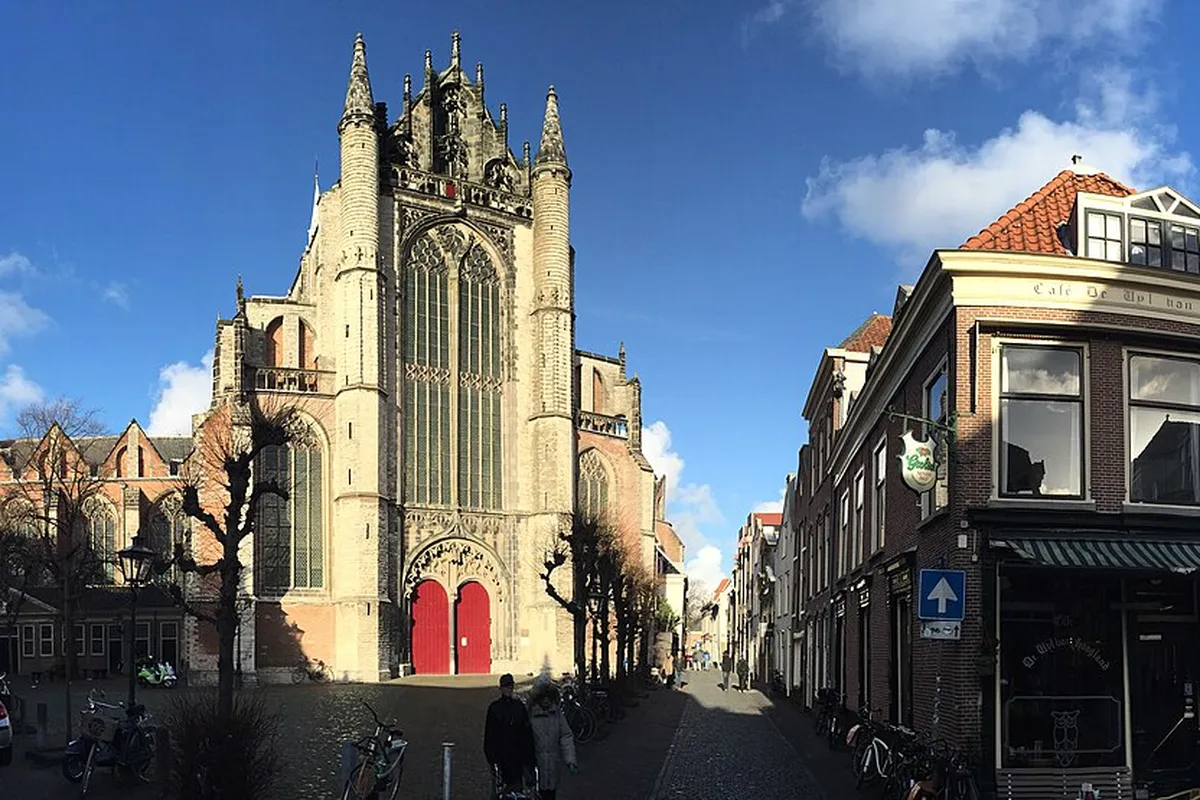 Photo: Leiden, the Netherlands. Source: Wikimedia Commons.
- Population: 130,481 (municipality; CBS, end of August 2026)
- Main language: Dutch; Leiden University (universiteitleiden.nl/en) and LUMC (lumc.nl/en) have English-language websites
- Key industries: biotech, pharmaceutical research, higher education, medical research
- Rail: Leiden Centraal is on the line between The Hague and Amsterdam; check the NS journey planner for current travel times
How many people live in Leiden? The municipality of Leiden has a population of 130,481 (CBS, end of August 2026), close to Zoetermeer (131,513) and larger than Delft (109,408), and much smaller than Rotterdam (673,437) or The Hague (568,301).
Leiden is a university city in the South Holland province, positioned between The Hague and Amsterdam on the main rail line. It is smaller and quieter than either, and for a certain type of expat — particularly those arriving for research, biotech, or pharma roles — it can be exactly the right size.
Leiden University was founded in 1575 (universiteitleiden.nl). Its academic hospital, LUMC, is in the city too. Johnson & Johnson Innovative Medicine and a range of biotech companies operate in the Leiden Bio Science Park, which calls itself the Netherlands’ largest bio science park.
The city has canals, a historic centre and several museums. It does not have the scale of amenities that Amsterdam or Utrecht offer.
Cost of Living
Leiden sits in the middle of the Dutch market. What makes Leiden unusual is not the rent but the municipal bill: the sewerage charge falls on the tenant, as explained below.
How to read the numbers below: rent is an editorial market indication — a range we publish from what private-sector listings look like, not a measured average, and individual flats vary widely. The national fixed costs (health insurance, groceries, utilities, connectivity, transport) are identical in every Dutch city; there is no Leiden discount on a health insurance policy or a supermarket shop. The only city-specific numbers that can be verified against a document are the municipal charges and the water authority charges, because both are set annually in a published tax ordinance. So that is where we put the precision.
In Leiden the combined local charges for a family of four come to €1,086.05 a year, roughly €91 a month. The reason is a single clause in one ordinance, explained below.
Rent (base rent, editorial market indication)
| Item | Monthly range |
|---|---|
| 1-bedroom apartment (private rental) | €1,050–€1,300 |
| 2-bedroom apartment | €1,400–€1,700 |
Editorial market indication for private-sector rentals, ExpatNetherlandsHub, August 2026 — base rent excluding servicekosten and utilities. Individual listings vary widely by neighbourhood, energy label and furnishing.
Leiden is a university city, so rooms and studios are part of the rental supply alongside self-contained flats. If a flat is not available straight away, a room can be a first step while you arrange a Dutch contract and a BSN.
Disclosure: the link below is an affiliate link. If you sign up through it we may earn a commission at no extra cost to you.
Search rooms and studios on Kamernet →
The costs that are the same in every Dutch city
Except for health insurance, which is a published national average, these ranges are planning assumptions from our own Cost of Living in the Netherlands 2026 guide, not measured figures. They apply nationally and do not change because you chose Leiden over Rotterdam; check your own bills and the providers’ current prices.
| Component | Single | Couple | Family (2 adults + 2 children) |
|---|---|---|---|
| Health insurance (basic policy, per adult; Rijksoverheid average 2026) | €157 | €314 | €314 (children under 18 free) |
| Groceries | €250–€350 | €400–€550 | €600–€850 |
| Utilities (gas, electricity, water) | €150–€250 | €180–€280 | €220–€350 |
| Internet + mobile | €50–€80 | €70–€110 | €80–€130 |
| Transport (OV + bike) | €100–€200 | €150–€300 | €200–€400 |
The midpoints used in the totals further down are €872/month for a single person (157 + 300 + 200 + 65 + 150), €1,334 for a couple (314 + 475 + 230 + 90 + 225) and €1,729 for a family of four (314 + 725 + 285 + 105 + 300).
On the health insurance line: in 2026 the Rijksoverheid puts the average basic premium at €157 per month, and the statutory deductible (eigen risico) is €385 a year. Every basic policy covers the same statutory care by law, so the only things you are comparing are price and service — see the Healthcare & Insurance section below for the comparison link.
Local charges: the one number that really is city-specific
Two sets of local taxes apply to a tenant: those of Gemeente Leiden and those of the water authority, Hoogheemraadschap van Rijnland. Both are set out in ordinances you can read.
| Charge (2026) | Single | Couple | Family (3+) | Ordinance |
|---|---|---|---|---|
| Afvalstoffenheffing (waste levy) | €269.52 | €387.60 | €505.68 | Verordening afvalstoffenheffing Leiden 2026, art. 4 |
| Riool- en waterzorgheffing — tenant portion | €67.68 | €98.16 | €129.84 | Leiden riool- en waterzorgheffing ordinance 2026 |
| Riool- en waterzorgheffing — owner portion (landlord pays) | €89.76 | €89.76 | €89.76 | same ordinance |
| Watersysteemheffing ingezetenen (per home) | €162.92 | €162.92 | €162.92 | Rijnland watersysteemheffing 2026 |
| Zuiveringsheffing (€95.87 per pollution unit) | €95.87 | €287.61 | €287.61 | Rijnland zuiveringsheffing 2026 |
The waste levy is the tenant’s bill, everywhere in the Netherlands. It is charged to the household that uses the property, not the owner, and in Leiden it steps up with household size: one occupant, two, then three or more.
The sewerage charge is where Leiden stands out. In many Dutch municipalities the sewerage charge (rioolheffing) is levied on the property owner; check your own municipality’s ordinance. Leiden instead levies a combined riool- en waterzorgheffing with a user portion scaled by household size — and that user portion falls on the occupant. A tenant in Leiden pays €67.68 for one occupant, €98.16 for two, or €129.84 for three or more, on top of the €89.76 the owner pays. This is the standard residential tariff, not a surcharge for heavy water users. The consequence is the one already flagged above: for a family of four, Leiden’s combined local charge is €1,086.05 a year (€91 a month).
The water authority taxes are separate from the municipal ones, and a tenant pays both of Rijnland’s parts — the flat watersysteemheffing per home and the zuiveringsheffing for wastewater treatment. Rijnland charges €95.87 per pollution unit in 2026.
The pollution-unit rule is statutory and blunt: a home occupied by one person counts as 1 pollution unit (vervuilingseenheid), and a home occupied by more than one person counts as 3 — however many more. That is why the jump from a single person to a couple is so steep here (€95.87 to €287.61 for the same service), and why a couple and a family of six pay exactly the same zuiveringsheffing.
Adding it up, the combined local charges a tenant in Leiden actually pays:
| Household | Per year | Per month |
|---|---|---|
| Single | €595.99 | €50 |
| Couple | €936.29 | €78 |
| Family of four | €1,086.05 | €91 |
You can object to an assessment, and eligible low-income households may apply for remission (kwijtschelding). Use the current assessment page for the deadline and procedure; our cost-of-living guide provides wider budget context.
Monthly total by household profile
Rent midpoint plus the national fixed midpoint plus the local charge per month:
| Profile | Rent | National fixed costs | Local charges | Total |
|---|---|---|---|---|
| Single, 1-bedroom | €1,175 | €872 | €50 | 1,175 + 872 + 50 = €2,097 |
| Couple, 1-bedroom | €1,175 | €1,334 | €78 | 1,175 + 1,334 + 78 = €2,587 |
| Family of four, 2-bedroom | €1,550 | €1,729 | €91 | 1,550 + 1,729 + 91 = €3,370 |
What those totals do not include: income tax and the effect of the 30% ruling; one-off setup costs such as the deposit, furnishing an unfurnished Dutch rental and any agency fee; childcare; international school fees; and a car. Any of those can change the picture substantially — a family paying international school fees in The Hague is in a different budget bracket entirely.
Municipal and water authority tariffs above are the 2026 rates as adopted in each body’s own tax ordinance, retrieved from lokaleregelgeving.overheid.nl on 21 August 2026. Rent figures are an editorial market indication, not a measured average. Local rates are reset every year — check your own assessment.
To run your own numbers: the Housing Budget Checker shows what your budget covers in Leiden before you start looking, the Cost of Living Calculator compares Leiden against other Dutch cities, the Salary Checker benchmarks an offer against Dutch market rates, and the 30% Ruling Calculator shows the net effect of the ruling. For the relocation itself, see Moving to Leiden: Complete Expat Guide 2026 and finding housing in the Netherlands. If you are paying a Dutch deposit from an account abroad, the Wise account in the Getting Started section below handles the transfer at the quoted exchange rate.
Best Neighbourhoods for Expats
Centrum — The historic centre, with canals, the Pieterskerk and university buildings among residential streets. A mix of student housing and apartments; parking in the centre is limited.
Professorenwijk — A residential neighbourhood with larger properties and family homes.
Stevenshof — A residential neighbourhood in the south of the city, more modern in construction.
Merenwijk — A residential neighbourhood in the north of the city, with a mix of family homes and apartments.
Working in Leiden
The Leiden Bio Science Park describes itself as the Netherlands’ first, largest and most comprehensive bio science park (leidenbiosciencepark.nl); its occupants include Johnson & Johnson Innovative Medicine and a range of spin-offs and scale-ups in biotech, pharma and medical research.
Leiden University Medical Centre (LUMC) is Leiden’s academic hospital and a research institute. Leiden University itself employs academic staff across all faculties.
Outside academia and life sciences, Leiden is a smaller job market than The Hague or Amsterdam, both of which are on the same rail line.
For coworking, PLNT, a startup incubator at Langegracht 70 in the city centre, rents out startup workspaces in its building (plnt.nl).
For salary benchmarking use the Salary Checker. Use the 30% Ruling Calculator to see how much tax you could save. If you have a foreign degree, check recognition requirements with the Diploma Evaluator. See the Working in the Netherlands guide for broader context.
Getting Registered
Registration is handled by Gemeente Leiden: schedule an appointment for your registration within five days of your move (Gemeente Leiden, checked 29 September 2026).
For some groups of newcomers, the Leiden International Centre (LIC) organises registration appointments at the municipality for highly skilled migrants, intra-corporate transferees, scientific researchers, entrepreneurs, recent graduates and EU citizens with at least a bachelor’s degree, and their families; it charges a fee for its assistance (Gemeente Leiden, gemeente.leiden.nl/english, checked 29 September 2026). If you are arriving through Leiden University or LUMC, ask your employer before you arrive what arrival support it offers.
Bring a valid ID, your rental or purchase contract (plus the landlord’s or main occupant’s permission form if you move in with someone) and, if this is your first registration in the Netherlands, your birth certificate and any marriage certificate, legalised where required. According to Gemeente Leiden, processing takes at least 5 working days; your BSN follows once the registration is processed.
Not sure which visa you need? Use the Visa Checker to find out. Use the BSN Planner to prepare your documents before your appointment. Planning your integration path? Use the Inburgering Route Planner to see your requirements.
Healthcare & Insurance
LUMC is Leiden’s academic hospital. For general practice, register with a GP (huisarts) near your home soon after you arrive; ask practices directly whether they accept new patients.
Health insurance is mandatory once you live or work in the Netherlands. In 2026 the average basic policy costs €157 per month (Rijksoverheid), and the standard annual deductible (eigen risico) is €385. The statutory cover is identical, so comparing premiums is worthwhile. Compare Dutch health insurance options with our Health Insurance Wizard → Use the Health Insurance Wizard to compare policies. Compare Dutch and international expat insurance options with the Insurance Comparison.
Transport
Leiden Centraal is on the rail line between Amsterdam and The Hague, with trains to Schiphol Airport. Utrecht is reachable via Alphen aan den Rijn. Check the NS journey planner for current times and frequencies.
Within the city, cycling is common, and the Bio Science Park is a short cycle from the centre. Buses connect the neighbourhoods to the station.
For a full guide to OV travel in the Netherlands, see the OV-chipkaart guide for expats.
Practical Tips for Your First Weeks in Leiden
The Hortus Botanicus is the oldest botanical garden in the Netherlands, laid out in 1590. Entry is free for Friends of the Hortus (Vrienden van de Leidse Hortus) and for Museumkaart holders (hortusleiden.nl).
Parking in the Centrum is limited. If you have a car, a resident’s permit (bewonersvergunning) for a specific zone is available through the municipality; since May 2024 the city centre (zone A) has a cap on resident permits, with four waiting-list areas (Gemeente Leiden).
Getting Started in Leiden
Moving to Leiden requires a few first steps. Here are the most important ones:
Arrange payment details — A Dutch bank account is the usual choice for rent, salary and daily payments. Wise offers a multi-currency account for sending, receiving and converting money. It is provided by Wise Europe SA, a payment institution authorised by the National Bank of Belgium, so it is not a Dutch bank account. Open a Wise account → Use the Bank Account Comparison to find the right Dutch bank for your situation.
Get health insurance — Dutch health insurance (zorgverzekering) is mandatory. Compare Dutch health insurance options with our Health Insurance Wizard →
Consider expat insurance — If you’re still settling in or working remotely, SafetyWing offers global travel medical cover; check the current price on SafetyWing’s site. Get SafetyWing coverage →
Plan your budget — Use our free cost of living calculator and housing budget checker to see what you can afford in Leiden.
Expat Community & Social Life
Much of Leiden’s international community is linked to the university, LUMC and the Bio Science Park. If you arrive through the university or LUMC, ask your employer what arrival support it offers; the Leiden International Centre (LIC) also helps newcomers, for a fee.
Cultural highlights include Museum De Lakenhal (city history and art) and the Hortus Botanicus, founded in 1590 and the oldest botanical garden in the Netherlands. The city-centre market runs on Wednesdays and Saturdays (08:00–17:00) (Gemeente Leiden).
The area around the Beestenmarkt and the Breestraat has many bars and restaurants.
Schools and Families
Families choose between Dutch-medium schools and international schools in the region, including in The Hague. Check each school’s admission rules and waiting lists directly before you commit to an address.
Leiden is compact, and the canals and the Hortus Botanicus are easy weekend outings for families.
Housing Search: Practical Advice
Start your search early. Listings appear on platforms such as Pararius and Funda, and rooms and studios on Kamernet. If you arrive through Leiden University or LUMC, ask your employer’s international office what housing support it offers.
If you need a furnished short-term option on arrival, plan for it in advance.
Daily Life in Leiden
Leiden is a compact city with a historic canal centre.
The city-centre market runs on Wednesdays and Saturdays (08:00–17:00) (Gemeente Leiden).
Museums include the Rijksmuseum van Oudheden (national antiquities museum), Museum De Lakenhal (city history and art) and Naturalis Biodiversity Center (natural history). The Hortus Botanicus, founded in 1590, is the oldest botanical garden in the Netherlands.
The Hague, with its larger shops and the beach at Scheveningen, is on the same rail line.
Settling In: The First Month
- Confirm housing and check that registration is permitted at the address
- Make an appointment with Gemeente Leiden (leiden.nl) for your registration within five days of your move
- Receive your BSN once the registration is processed; the Leiden International Centre (LIC) can arrange the registration appointment for highly skilled migrants and some other groups, for a fee
- Open a Dutch bank account
- Take out Dutch health insurance
- Register with a GP near your home
- Apply for DigiD after your BSN is confirmed
Frequently Asked Questions
What is the population of Leiden?
Leiden has a population of 130,481 (CBS, end of August 2026). That includes the whole gemeente, not just the historic centre.
Is Leiden bigger or smaller than you’d expect?
Leiden’s 130,481 residents put it close to Zoetermeer in size, and well below Amsterdam or Rotterdam. It has a university, an academic hospital, several museums and the Bio Science Park.
How many people live in Leiden compared to Amsterdam or The Hague?
Leiden’s 130,481 residents are a fraction of Amsterdam’s 946,856 or The Hague’s 568,301 (all CBS, end of August 2026). Leiden sits between the two on the rail line but is much closer in size to Zoetermeer than to either of its larger neighbours.
How many internationals live in Leiden?
Leiden has a sizeable international community, and a nationality count excludes internationals who hold Dutch nationality; the municipality’s statistics pages give current figures. Leiden University, LUMC and the Bio Science Park are the city’s main international employers.
Is Leiden bigger than Delft or Zoetermeer?
Leiden (130,481) is larger than Delft (109,408) and slightly smaller than Zoetermeer (131,513), according to CBS figures for the end of August 2026. It is much smaller than Rotterdam or The Hague.
Is Leiden a good place to live as an expat?
It depends on your work and what you want from a city. For researchers, academics and biotech or pharma professionals, the university, LUMC and the Bio Science Park are the main employers, and the city is compact. Outside those sectors the job market is smaller, with The Hague and Amsterdam on the same rail line. If you want big-city amenities, Leiden’s size may feel restrictive.
Do tenants pay the sewerage charge in Leiden?
Yes. Leiden levies a combined riool- en waterzorgheffing with a user portion that falls on the occupant: €67.68 a year for one occupant, €98.16 for two, and €129.84 for three or more, on top of the €89.76 the owner pays. In many municipalities the sewerage charge sits with the property owner; in Leiden the tenant pays a user portion. The figures are the 2026 rates in the Leiden ordinance, retrieved from lokaleregelgeving.overheid.nl on 21 August 2026.
Why is Leiden’s local tax bill high?
Two things stack. First, the tenant sewerage portion described above: a Leiden family pays €129.84 a year for the user portion, which falls on the occupant. Second, the water authority: Rijnland charges €95.87 per pollution unit in 2026, and the zuiveringsheffing triples once a second person registers at the address. On the 2026 ordinances, a family of four pays €1,086.05 a year in Leiden.
What does a family of four need per month in Leiden?
Roughly €3,370 a month on our figures: €1,550 rent (midpoint of our €1,400–€1,700 editorial market indication for a two-bedroom), €1,729 in national fixed costs from our Cost of Living in the Netherlands 2026 guide, and €91 in local charges from the 2026 Leiden and Rijnland ordinances. That excludes income tax and the 30% ruling, the deposit and furnishing an unfurnished rental, childcare, international school fees, and a car.
How much is the waste tax in Leiden in 2026?
€269.52 a year for a single-occupant household, €387.60 for two occupants, and €505.68 for three or more, under the Verordening afvalstoffenheffing Leiden 2026, art. 4. It is charged to the household using the property, so a tenant pays it directly rather than through the landlord. Eligible low-income households can apply to the municipality for remission (kwijtschelding); verify the current eligibility test and deadline on Leiden’s assessment page.
Is Leiden cheaper than Amsterdam?
On rent, clearly: about 29% cheaper on a one-bedroom and 30% on a two-bedroom, comparing the midpoints of our own market ranges (€1,175 against €1,650, and €1,550 against €2,200). On local charges, no: Leiden’s €91 a month for a family of four is above Amsterdam’s €78, because in Amsterdam the sewerage charge is levied on the owner and a tenant pays €0. All in, a single person is looking at about €2,097 a month in Leiden against about €2,575 in Amsterdam on the same national fixed costs (see our Amsterdam guide). Rent is what moves the total.