In this guide
Rotterdam at a Glance
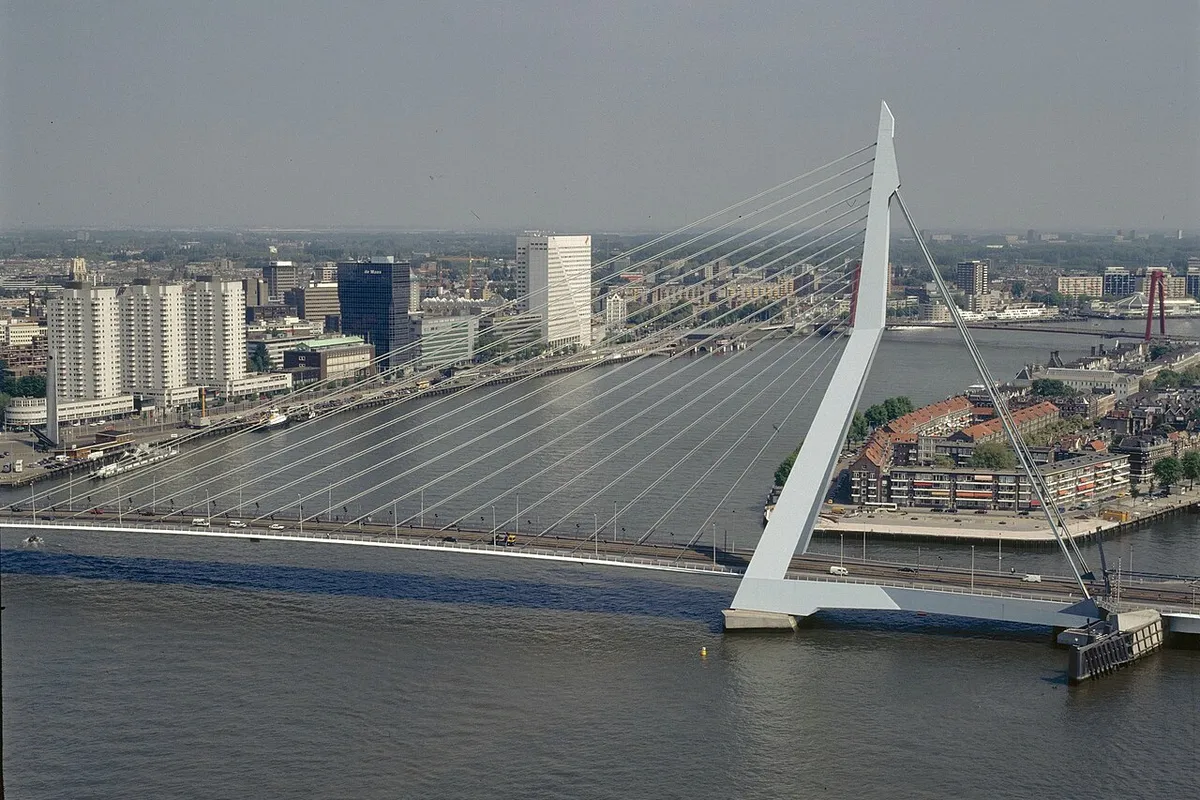 Photo: Rotterdam, the Netherlands. Source: Wikimedia Commons.
- Population: 673,437 (municipality; Statistics Netherlands, end of August 2026), the second largest city in the Netherlands
- Main languages spoken: Dutch, with English used in many professional settings
- Key industries: port and logistics, architecture, cleantech, construction, retail
- Local transport: metro, tram and bus run by RET, plus national rail from Rotterdam Centraal
Rotterdam is the city many people compare with Amsterdam when they weigh up where to live. The city centre was largely destroyed in the Second World War and rebuilt, which is why it looks different from other Dutch cities: the architecture is contemporary and sometimes experimental. If you want canals and gabled houses, look elsewhere. If you want a port city with a working, international character, it is worth considering.
Cost of Living
Rent is the biggest and most variable cost, and this page does not publish a rent average because we have no measured statistic to base one on. Check current listings on the platforms below before you decide. The national costs (health insurance and the like) are the same in every Dutch city: there is no Rotterdam discount on a health insurance premium. The one set of figures that is specific to Rotterdam and can be checked line by line is the municipal and water authority charges. They are adopted every year in published tax ordinances, so they are listed in full below.
Finding a room or flat
If you need a room or a studio while you look for something longer-term, the shared-rental market runs on its own platforms.
Disclosure: the link below is an affiliate link. If you sign up through it we may earn a commission at no extra cost to you. It does not change what we recommend.
Search rooms and studios on Kamernet →
Health insurance
The 2026 average basic policy is about €157 per month per adult (Rijksoverheid), and the statutory deductible (eigen risico) is €385 per year. Basic cover is defined by law and is the same whichever insurer you sign with, so the difference is price and service only. Use the Health Insurance Wizard to compare.
Local charges: the one number that really is city-specific
| Charge 2026 | Single (1 person) | Couple (2 persons) | Family (4 persons) | Ordinance |
|---|---|---|---|---|
| Afvalstoffenheffing (waste levy) | €381.90 | €457.50 | €495.30 | Verordening afvalstoffenheffing 2026, art. 5 |
| Rioolheffing (sewerage), tenant | €0 | €0 | €0 | Verordening rioolheffing 2026 |
| Rioolheffing, owner pays | €319.10 | €319.10 | €319.10 | as above |
| Watersysteemheffing ingezetenen (per home) | €152.25 | €152.25 | €152.25 | Schieland en de Krimpenerwaard |
| Zuiveringsheffing (€79.34 per v.e.) | €79.34 (1 v.e.) | €238.02 (3 v.e.) | €238.02 (3 v.e.) | Schieland en de Krimpenerwaard |
Five things about this table are worth reading properly.
The waste levy is the tenant’s bill. Gemeente Rotterdam charges the afvalstoffenheffing per property and per calendar year, banded by household size: €381.90 for one person, €457.50 for two, €495.30 for three or more.
The sewerage charge is levied on the owner, so a tenant pays €0. The owner pays €319.10 for 2026 on homes with a WOZ value of €50,000 or more, and €63.80 on homes valued below that.
The waterschap bill is separate from the gemeente bill. The flat watersysteemheffing for residents is €152.25 per home, and there is a zuiveringsheffing for wastewater treatment on top.
The 1 v.e. / 3 v.e. rule explains the jump from single to couple. The zuiveringsheffing is charged per vervuilingseenheid (pollution unit): a home used by one person counts as 1 v.e., any other home as 3 v.e. At €79.34 per unit that is €79.34 for one person and €238.02 for a larger household.
Check which water authority you are in. The figures above are those of Hoogheemraadschap van Schieland en de Krimpenerwaard. Which water authority applies depends on your address, and each sets its own rates, so check the authority named on your assessment.
Combined, the bills a Rotterdam tenant receives come to:
| Household | Per year | Per month |
|---|---|---|
| Single | €613.49 | ~€51 |
| Couple | €847.77 | ~€71 |
| Family of four | €885.57 | ~€74 |
The arithmetic: single 381.90 + 152.25 + 79.34 = 613.49; couple 457.50 + 152.25 + 238.02 = 847.77; family 495.30 + 152.25 + 238.02 = 885.57.
Tariffs above are the 2026 rates as adopted in each body’s own tax ordinance, retrieved from lokaleregelgeving.overheid.nl on 6 October 2026. Local rates are reset every year, so check your own assessment.
One-off costs matter too: the maximum rental deposit is two months of bare rent for contracts from 1 July 2023, and an unfurnished Dutch rental is often delivered without flooring or light fittings.
Use the Housing Budget Checker to model your budget and the Cost of Living Calculator to compare cities. On the income side, the Salary Checker and the 30% Ruling Calculator show what lands in your account. For the search itself, see Moving to Rotterdam: Full Guide 2026 and finding housing in the Netherlands. If you pay a deposit from a foreign account, compare the provider’s live quote and confirm that the recipient details and transfer route are supported.
Neighbourhoods
Rotterdam’s neighbourhoods differ a lot in character. Kralingen is known for the Kralingse Bos park, Delfshaven for its historic harbour, Katendrecht and Kop van Zuid for waterfront redevelopment, Blijdorp for being residential and close to the zoo, and the Centrum for being close to transport and amenities. Rents differ by neighbourhood, energy label and furnishing, so compare current listings rather than relying on an average.
Working in Rotterdam
The Port of Rotterdam drives employment in logistics, shipping, customs, warehousing and supply chain management. If your background is in one of these areas, Rotterdam is a natural market to search. Architecture and design firms are also based in the city, for example OMA.
For salary benchmarking use the Salary Checker. Use the 30% Ruling Calculator to see how much tax you could save as a highly skilled migrant. If you have a foreign degree, check recognition requirements with the Diploma Evaluator. More detail on working in the Netherlands at /guides/work/.
Getting Registered
Registration is handled by Gemeente Rotterdam. You need a fixed address to register, and you can book appointments online. You will need your passport and proof of your address and status; the municipality tells you what it requires when you book. Your BSN is issued when you are registered in the BRP. Some landlords of furnished or serviced apartments do not allow registration at the address, so check this before you sign.
Use the BSN Planner to prepare your documents. Not sure which visa you need? Use the Visa Checker. Planning your integration path? The Inburgering Route Planner shows your requirements.
Healthcare & Insurance
Hospitals in Rotterdam include Erasmus MC (an academic medical centre), Franciscus Gasthuis and Maasstad Ziekenhuis. Ask GP practices in your area whether they accept new patients and consult in English.
Dutch health insurance is mandatory: take it out as soon as you can and no later than 4 months after arriving, with cover from the day you arrived (Government.nl). The average basic premium in 2026 is €157/month (Rijksoverheid), with the standard €385 eigen risico (annual deductible). Compare Dutch and international expat insurance options with the Insurance Comparison.
Transport
Rotterdam has a metro system, which is unusual among Dutch cities, plus trams and buses operated by RET. Cycling is popular, and Rotterdam Centraal is the main rail hub for journeys outside the city. For a full explanation of how OV travel works, see the OV-chipkaart guide for expats.
Getting Started in Rotterdam
Arrange payment details. A Dutch bank account is convenient for local payments, but a reachable SEPA account cannot simply be rejected because its IBAN is from another Member State. Wise gives verified customers EUR account details with a non-Dutch euro IBAN (Wise uses a Belgian BIC and address) rather than an NL IBAN. Open a Wise account →
Get health insurance. Dutch health insurance (zorgverzekering) is mandatory. The basic package is the same at every insurer, so compare premium, policy type and supplementary cover. Compare Dutch health insurance options with our Health Insurance Wizard →
Consider expat insurance. If you are still settling in or working remotely, SafetyWing offers global coverage from USD 62.72 per 4 weeks (ages 18-39). Get SafetyWing coverage → Note that if you live in the Netherlands you are in principle required to hold Dutch basic health insurance.
Compare banks. Use the Bank Account Comparison to find the right Dutch bank for your situation.
Plan your budget. Use the cost of living calculator and housing budget checker.
Housing Search: Practical Advice
Pararius and Funda are major rental platforms. You will usually be asked for proof of income, such as payslips and an employment contract or employer declaration. The maximum deposit is two months of bare rent for contracts from 1 July 2023.
The Affordable Rent Act (Wet betaalbare huur) has been in force since 1 July 2024 and applies to new contracts signed on or after that date. It can bring mid-priced homes under the points-based rent cap, so ask the landlord or agent whether the home is regulated.
Settling In: The First Month
- Finalise housing with a rental contract that allows registration at the address.
- Book registration at Gemeente Rotterdam.
- Attend the registration and receive your BSN.
- Open a bank account. If you need a euro IBAN before your BSN arrives, Wise gives verified customers EUR account details with a non-Dutch euro IBAN (Wise uses a Belgian BIC and address). ABN AMRO and ING also offer accounts without a BSN at the start; see our bank guide.
- Sign up for health insurance within the deadline above.
- Register with a GP.
- Apply for DigiD after receiving your BSN.
Related Guides
Frequently Asked Questions
How much is the waste tax in Rotterdam in 2026?
The afvalstoffenheffing for 2026 is EUR 381.90 a year for a one-person household, EUR 457.50 for two people and EUR 495.30 for three or more (Verordening afvalstoffenheffing 2026, article 5, Gemeente Rotterdam). It is charged to the household that uses the property, so as a tenant this bill comes to you.
Do I pay the sewerage charge in Rotterdam as a tenant?
No. Rotterdam's rioolheffing is charged to the person who holds the property through ownership or a limited right (article 3 of the ordinance). For 2026 a home with a WOZ value of EUR 50,000 or more pays EUR 319.10 and a home below that pays EUR 63.80. A tenant does not receive this bill.
Which water authority covers Rotterdam?
Hoogheemraadschap van Schieland en de Krimpenerwaard sets 2026 rates of EUR 152.25 watersysteemheffing per home and EUR 79.34 per pollution unit for the zuiveringsheffing. Which water authority applies depends on the address, and every authority sets its own tariffs. Your annual assessment names your authority, so read it rather than assuming.
Why does the water treatment charge jump when a second person moves in?
For the zuiveringsheffing a home used by one person counts as 1 pollution unit and any other home counts as 3 (article 14 of the Schieland ordinance). At EUR 79.34 per unit that is EUR 79.34 for one person and EUR 238.02 for a larger household.
When must I take out Dutch health insurance in Rotterdam?
You must take out Dutch health insurance as soon as possible and no later than 4 months after you arrive. Cover applies from the day you arrived (Government.nl).