In this guide
Utrecht at a Glance
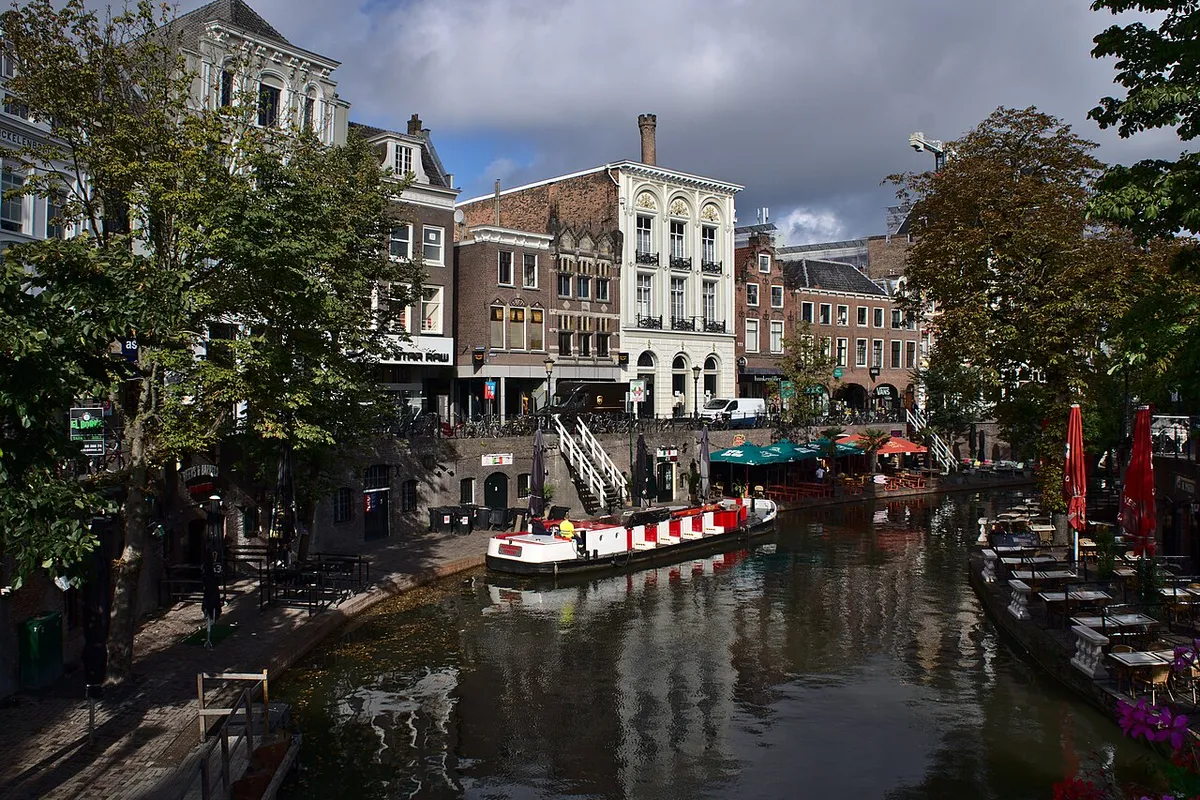 Photo: Utrecht, the Netherlands. Source: Wikimedia Commons.
- Population: 377,551 (municipality; Statistics Netherlands, start of August 2026), making it the fourth largest city in the Netherlands
- Main languages spoken: Dutch, with English widely used in the university and academic environment
- Key sectors: healthcare, higher education, gaming and software, financial services
Utrecht sits at the centre of the country and is a major rail hub, with frequent direct trains to Amsterdam, Rotterdam, The Hague and Eindhoven (check journey times and timetables on ns.nl). That makes it a practical base for expats who are not certain where their career will take them, or who have partners working in different cities.
The city has a canal system with wharf-level cafés and restaurants along the Oudegracht. Utrecht Centraal is connected to the Hoog Catharijne shopping centre, and Utrecht University gives the city a large student and academic population.
Cost of Living
Utrecht is a popular city and the rental market is tight. We do not give a rent range for Utrecht or its neighbourhoods here: the rent figures that are publicly available are asking prices from commercial listing sites, and individual rents vary widely by neighbourhood, energy label and furnishing. Check current listings and ask for the servicekosten (service charges) on top of the base rent before you compare two flats.
Utrecht has many students, so the room and studio market is large, and for a single arrival it can be a realistic first step.
Disclosure: the link below is an affiliate link. If you sign up through it we may earn a commission at no extra cost to you. It does not change what we recommend.
Search rooms and studios on Kamernet →
Health insurance and other costs that do not depend on the city
The 2026 average basic health insurance premium is €157 per month per adult (Rijksoverheid), and the statutory deductible (eigen risico) is €385 per year. Basic cover is set by law and identical across insurers, so what differs is price and service. Children under 18 are covered free on a parent’s policy. Use the Health Insurance Wizard to compare. For groceries, utilities, internet and transport, see our Cost of Living in the Netherlands 2026 guide; these costs are not specific to Utrecht.
Local charges: the one number that really is city-specific
| Charge 2026 | Single (1 person) | Couple (2 persons) | Family (4 persons) | Ordinance |
|---|---|---|---|---|
| Afvalstoffenheffing (waste levy) | €346.25 | €443.30 | €600.05 | Verordening afvalstoffenheffing gemeente Utrecht 2026 |
| Rioolheffing (sewerage) — tenant | €0 | €0 | €0 | Verordening rioolheffing Utrecht 2026 |
| Rioolheffing — owner pays | €247.27 | €247.27 | €247.27 | as above |
| Watersysteemheffing ingezetenen (per home) | €126.98 | €126.98 | €126.98 | Hoogheemraadschap De Stichtse Rijnlanden |
| Zuiveringsheffing (€78.48 per v.e.) | €78.48 (1 v.e.) | €235.44 (3 v.e.) | €235.44 (3 v.e.) | Hoogheemraadschap De Stichtse Rijnlanden |
Four points make this table make sense.
The waste levy is the tenant’s bill. Gemeente Utrecht charges the afvalstoffenheffing to the household using the property, and unlike most cities on this site it keeps banding all the way up: €346.25 for one person, €443.30 for two, €527.80 for three and €600.05 for four or more. A third and fourth occupant each add real money, so a family arriving in stages will see the assessment change more than once.
The sewerage charge in Utrecht is levied on the owner, so as a tenant you pay €0. The owner pays €247.27 for 2026, and there is a user portion only above 250 m³ of water a year — a threshold a household does not reach. Expats routinely budget for a rioolheffing bill they will never receive; in Utrecht that is your landlord’s cost, and it is worth saying plainly rather than letting people reserve €247 for nothing.
The waterschap bill is separate from the gemeente bill, and tenants pay both of its parts. Utrecht falls under Hoogheemraadschap De Stichtse Rijnlanden. You pay a flat watersysteemheffing of €126.98 per home plus a zuiveringsheffing for treating your wastewater. Two authorities, two envelopes, two payment references — and the waterschap one arrives on its own schedule, which is why people assume it is a duplicate of the municipal bill.
The 1 v.e. / 3 v.e. rule explains the steep jump from single to couple. The zuiveringsheffing is charged per vervuilingseenheid (pollution unit). One occupant counts as 1 v.e.; more than one occupant counts as 3 v.e., however many more. At €78.48 per unit that is €78.48 alone and €235.44 the moment a second person registers at the address — exactly what a family of five pays. Combined with Utrecht’s finely banded waste levy, this is why the single-to-couple step here is the sharpest part of the whole bill.
Combined, the bills a Utrecht tenant actually receives come to:
| Household | Per year | Per month |
|---|---|---|
| Single | €551.71 | ~€46 |
| Couple | €805.72 | ~€67 |
| Family of four | €962.47 | ~€80 |
For objection and remission (kwijtschelding), use Utrecht’s current assessment page. Our cost-of-living guide explains how local charges affect a household budget.
One-off costs to budget separately: a deposit (legally capped at two months of base rent for contracts since 1 July 2023), furnishing an unfurnished Dutch rental, and an agency fee where one applies. Income tax and the 30% ruling also affect what you take home.
Municipal and water authority tariffs above are the 2026 rates as adopted in each body’s own tax ordinance (lokaleregelgeving.overheid.nl, checked 8 October 2026). Local rates are reset every year, so check your own assessment.
Use the Housing Budget Checker to work out what is realistic given your income before committing to a search, and the Cost of Living Calculator to compare cities. On the income side, the Salary Checker and the 30% Ruling Calculator show what actually reaches your account. For the search itself, see Moving to Utrecht: Full Guide 2026 and finding housing in the Netherlands. If you pay a deposit from a foreign account, compare the provider’s live quote and confirm that the recipient details and transfer route are supported.
Neighbourhoods
Lombok — A neighbourhood west of the centre with restaurants, markets and independent shops, within cycling distance of the city centre and the university.
Wittevrouwen — Characterful streets near the Griftpark, popular with professionals and young families.
Leidsche Rijn — A large planned residential area west of the centre, developed over the past 20 years, with more modern housing stock and a well-established cycling route to the centre.
Centrum — The historic city centre, with the canal network and the Dom Tower.
We do not give rent ranges per neighbourhood; check current listings.
Working in Utrecht
Healthcare and higher education are major employers in Utrecht. UMC Utrecht is the university medical centre, and Utrecht Science Park (De Uithof) is a large campus that combines the university, the UMC and research institutes. Rabobank has its headquarters in Utrecht, and the region also has software, gaming and professional services companies.
For salary benchmarking use the Salary Checker. Use the 30% Ruling Calculator to see how much tax you could save. If you have a foreign degree, check recognition requirements with the Diploma Evaluator. See the Working in the Netherlands guide for more detail.
Getting Registered
If you stay in Utrecht for longer than 4 months, you must make an appointment with Gemeente Utrecht and register within 5 days of your arrival (utrecht.nl, registering from abroad). Appointments can take longer to get than usual, so book as soon as you have an address.
What to bring, according to the municipality: a valid ID for each person you register, proof that you are allowed to live in the Netherlands, your rental or purchase contract (or the homeowner’s permission on the declaration of residency form), and original foreign documents such as birth or marriage certificates where relevant. The municipality accepts English, German and French documents without a certified translation; foreign documents must meet the legalisation rules. Registration in the Basisregistratie Personen (BRP) can take up to 4 weeks, and you receive your BSN as part of it.
Some landlords do not allow registration at the address, for example in furnished short-term lets. Check this before signing anything, because you cannot register at a hotel or holiday address.
Use the BSN Planner to prepare and understand what to bring. Not sure which visa you need? Use the Visa Checker to find out. Planning your integration path? The Inburgering Route Planner shows your requirements.
Healthcare & Insurance
UMC Utrecht is the university medical centre in the city, and there are also general hospitals and clinics in the surrounding area. Practice opening hours, waiting lists and languages spoken differ per GP practice, so ask the practice directly before you register.
Dutch health insurance is mandatory: take it out as soon as you can and no later than 4 months after arriving, with cover from the day you arrived (Government.nl). The average basic premium in 2026 is €157/month (Rijksoverheid), with a €385 annual deductible. Use the Health Insurance Wizard to compare policies and find the right level of coverage. Compare Dutch and international expat insurance options with the Insurance Comparison.
Transport
Utrecht Centraal is a major hub of the Dutch rail network, with direct trains to the main cities; check ns.nl for timetables and journey times.
Within the city, cycling is a common way to get around, and the station area has large bicycle parking facilities. Buses and trams cover areas less served by cycling.
See the OV-chipkaart guide for expats for a full overview of how public transport payment works.
Practical Tips for Your First Weeks in Utrecht
Utrecht Centraal is large. The station is connected to the Hoog Catharijne shopping centre, which connects to the city centre. Follow the signs for Centrum or for the Jaarbeurs exhibition centre, depending on where you need to go.
The student housing market is separate from the professional rental market. Search results on rental platforms can include student-only listings. Check the conditions before you apply, because student housing is not open to non-students and can affect registration.
DigiD is important. DigiD sends an activation letter by post, so apply as soon as you have your BSN and activate within the period stated on the letter. You will need DigiD for tax filings, healthcare records and many municipal services. See our DigiD guide.
Getting Started in Utrecht
Moving to Utrecht requires a few first steps. Here are the most important ones:
Arrange payment details — A Dutch bank account is convenient for local payments, but a reachable SEPA account cannot simply be rejected because its IBAN is from another Member State. Wise gives verified customers EUR account details with a non-Dutch euro IBAN (Wise uses a Belgian BIC and address) rather than an NL IBAN. Open a Wise account →
Get health insurance — Dutch health insurance (zorgverzekering) is mandatory. The basic package is the same at every insurer, so compare premium, policy type and supplementary cover. Compare Dutch health insurance options with our Health Insurance Wizard →
Consider expat insurance — If you’re still settling in or working remotely, SafetyWing provides global coverage from USD 62.72 per 4 weeks (safetywing.com, October 2026). Get SafetyWing coverage →
Compare banks — Use the Bank Account Comparison to find the right Dutch bank for your situation.
Plan your budget — Use our free cost of living calculator and housing budget checker to see what you can afford in Utrecht.
Expat Community & Social Life
Utrecht has a large student and academic population, and international newcomers often meet people through the university, workplaces and local meetup groups. Language exchange events, usually held in cafés, are a practical way to meet Dutch people outside of work.
The Oudegracht, with its restaurants and cafés at water level, is a defining feature of the city centre. TivoliVredenburg is a major music venue, and the Netherlands Film Festival is held in Utrecht.
Cycling is the default way to get around for many residents, so a second-hand bike is one of the first practical purchases for most newcomers.
Schools and Families
Utrecht has international schools and primary schools with bilingual or international programmes. Check each school’s own website for curriculum, admission rules and waiting lists, and apply early.
Many expat families on longer-term placements also use Dutch state schools. Ask the school about how it supports children who do not speak Dutch.
Housing Search: Practical Advice
Utrecht’s housing market is tight. Pararius and Funda are widely used platforms, and English-speaking makelaars (estate agents) work in the expat market.
Make sure listings you view are not student-designated (studentenwoning), which sometimes appear in general search results; the distinction matters for registration too. Leidsche Rijn is a newer-build area to consider if you want more modern housing, and families should compare listings in several neighbourhoods.
To see new rentals sooner, you can set up alerts on the main platforms or use Dean, a paid alert service that says it checks more than 1,000 rental sources and compares new listings with your search profile. Dean says you can try it free for 3 days and cancel month-to-month.
Daily Life in Utrecht: What Makes It Work
The Oudegracht is a double-level canal: the upper level is a street with cyclist and pedestrian traffic, and the lower level is a quayside with restaurants, bars and cafés at water level.
The Dom Tower dominates the skyline and serves as a navigation landmark. Guided climbs are available; check the tower’s own site for opening times.
Weekly markets are held in the city centre; check the municipality’s market information for current days and locations.
Settling In: The First Month
The practical sequence for Utrecht:
- Secure housing with a lease that permits municipality registration — check this explicitly before signing
- Make an appointment with Gemeente Utrecht (afspraak.utrecht.nl) within 5 days of arrival
- Attend registration; your BSN follows from the BRP registration
- Open a Dutch bank account
- Register for health insurance
- Register with a GP in your neighbourhood
- Apply for DigiD online after receiving your BSN
Related Guides
Frequently Asked Questions
Is Utrecht cheaper than Amsterdam?
We do not publish a verified rent comparison between the two cities, because the rent figures available are asking prices from commercial listing sites. National fixed costs such as the basic health insurance premium are the same in every Dutch city. What does differ by city are the local charges: for 2026 a single tenant in Utrecht pays about EUR 552 a year in waste levy and water authority charges, and a family of four about EUR 962 (see the table in this guide).
How much is the waste tax in Utrecht in 2026?
The afvalstoffenheffing for 2026 is EUR 346.25 a year for one person, EUR 443.30 for two, EUR 527.80 for three and EUR 600.05 for four or more, under the Verordening afvalstoffenheffing gemeente Utrecht 2026 on lokaleregelgeving.overheid.nl. It is charged to the household using the property, so as a tenant this bill comes to you.
Do I pay the sewerage charge in Utrecht as a tenant?
No. Utrecht's rioolheffing has an owner part (EUR 247.27 per property for 2026) and a user part that only applies to water use above 250 m3 a year, so a normal household does not pay it. In Utrecht the sewerage charge is therefore your landlord's cost.
Why does the water authority treatment charge jump when a second person registers?
Hoogheemraadschap De Stichtse Rijnlanden charges the zuiveringsheffing at EUR 78.48 per vervuilingseenheid (pollution unit) for 2026. A home counts as 1 unit for one occupant and 3 units for more than one, so the charge goes from EUR 78.48 to EUR 235.44 when a second person registers at the address. The flat watersysteemheffing of EUR 126.98 per home does not change.
Do I have to register with the municipality when I move to Utrecht?
Yes, if you stay for longer than 4 months you must make an appointment and register with Gemeente Utrecht within 5 days of your arrival. Bring a valid ID, proof that you are allowed to live in the Netherlands, your rental contract or the homeowner's permission, and original foreign civil-status documents where relevant. Registration in the BRP also gives you your BSN.