I first visited Delft on a grey Tuesday in November, seven years before I eventually helped a client move there — and the city still surprised me. I had grown up hearing my Dutch mother talk about the blue-and-white pottery and Vermeer’s paintings, which honestly made me expect a glorified tourist trap. What I found instead was a city that gets on with itself quietly and confidently. The canals are genuinely beautiful, the old church tower leans at a worrying angle (this is normal, nobody panics), and within about twenty minutes of walking I counted six different nationalities having coffee at the same café terrace.
Since then I have helped dozens of expats relocate to Delft — mostly academics and engineers joining TU Delft or TNO, but also partners who followed them and ended up building their own lives there. This guide is what I tell every single one of them before they arrive.
Why Expats Choose Delft
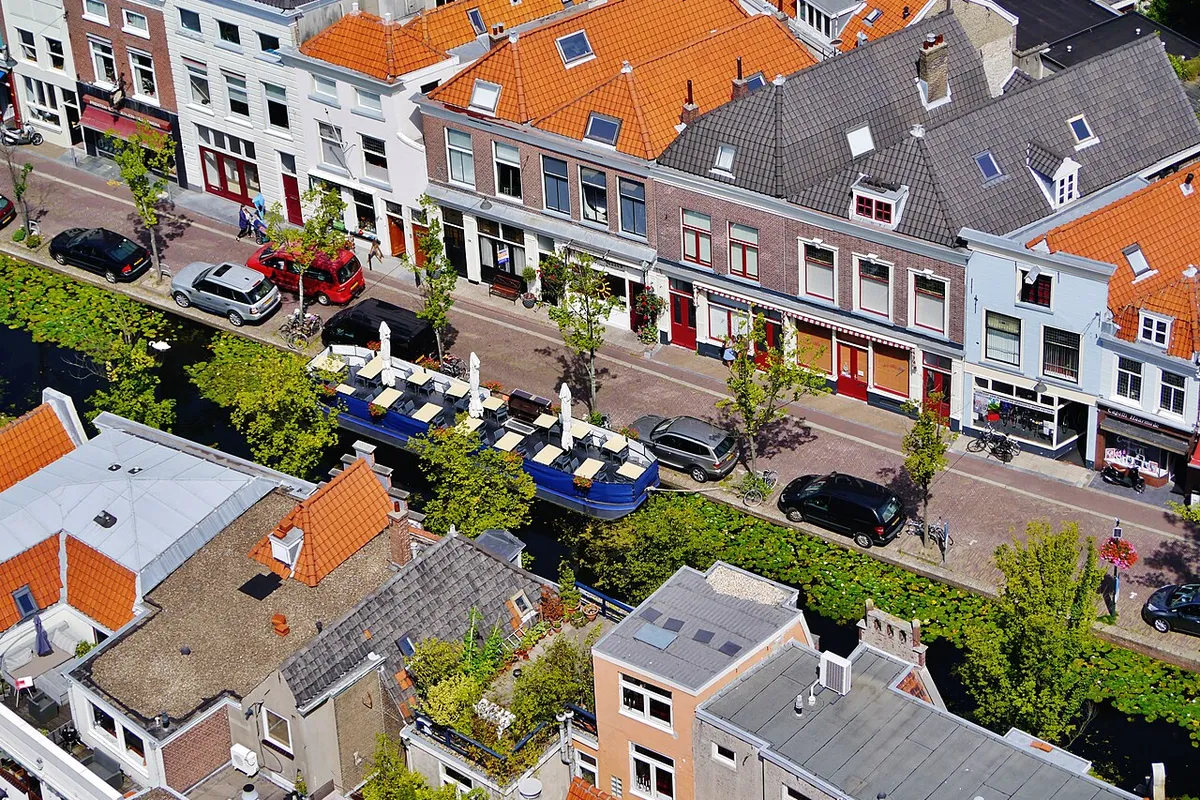 Photo: Delft, the Netherlands. Source: Wikimedia Commons.
Delft is not the obvious answer when people ask me where to live in the Netherlands. Amsterdam gets the glamour, Rotterdam gets the architecture crowd, The Hague gets the diplomats. Delft sits quietly in the middle of all three, 15 minutes by train from The Hague and 12 minutes from Rotterdam, and it has built a reputation as one of the most genuinely international small cities in the country.
The main draw is TU Delft — Technische Universiteit Delft — which consistently ranks among the top five engineering universities in Europe. Roughly 27,000 students study there, and a significant portion are international. The university runs its own housing matching service, employs thousands of researchers and staff from abroad, and has shaped the entire character of the city. If you are coming to work or study at TU Delft, Delft is the obvious choice. If you are working elsewhere in the Randstad and want something calmer and cheaper than Rotterdam or The Hague, Delft deserves serious consideration.
The other big employer is TNO (Netherlands Organisation for Applied Scientific Research), which has a large campus adjacent to TU Delft. Several tech spinoffs and scale-ups have grown up around both institutions, which means the city punches well above its 115,000-person population in terms of professional opportunities.
What people often underestimate is how much easier daily life is in Delft compared to Amsterdam. The housing market is competitive, but it is not the complete war zone you face in the capital. Most landlords and estate agents will respond to your messages. Viewings actually happen. English is spoken everywhere without a flicker of irritation. And the historic centre — the Binnenstad — is compact enough that you can walk from one side to the other in 25 minutes.
Cost of Living in Delft
Let me give you real numbers, because the generic “cheaper than Amsterdam” line does not actually help you budget.
Rent Prices in 2026
| Property type | City centre (Binnenstad) | Mid-city (Voorhof, Vrijenban) | Outer areas (Tanthof, Buitenhof) |
|---|---|---|---|
| Room in shared house | EUR 550–750/month | EUR 450–620/month | EUR 400–550/month |
| Studio (25–40m²) | EUR 950–1,200/month | EUR 800–1,050/month | EUR 700–900/month |
| 1-bedroom apartment | EUR 1,050–1,350/month | EUR 900–1,150/month | EUR 800–1,000/month |
| 2-bedroom apartment | EUR 1,400–1,800/month | EUR 1,200–1,550/month | EUR 1,050–1,350/month |
These are unfurnished prices. Furnished units add roughly EUR 100–200 per month. All prices include service costs but exclude utilities, which typically run EUR 100–180 per month for a one-bedroom depending on energy efficiency.
Compared to Amsterdam, you save roughly 25–35% on rent. Compared to Rotterdam, the difference is smaller — maybe 10–20% — but Delft’s city centre housing stock is older and more characterful, which many people prefer.
Use the Housing Budget Checker tool to work out what you can actually afford once you factor in Dutch income tax, health insurance, and other fixed costs.
Other Living Costs
- Groceries: Albert Heijn, Jumbo, and Aldi are all present. A realistic grocery budget for one person is EUR 250–350 per month eating at home most nights.
- Eating out: A main course at a mid-range restaurant is EUR 16–24. A coffee is EUR 3–4. Friday lunch at one of the market stalls near Markt square costs EUR 5–8.
- Public transport: A monthly OV-chipkaart subscription for the Rotterdam–Delft–The Hague corridor runs around EUR 90–130 depending on your specific route. See the OV-chipkaart guide for how to set one up.
- Cycling: Most people in Delft cycle everywhere within the city. A decent second-hand bike costs EUR 100–200. New quality bikes (Batavus, Gazelle) start at EUR 500.
- Health insurance: Mandatory in the Netherlands. Budget EUR 130–160 per month for a standard policy. Full details in the Dutch health insurance guide.
For a broader comparison with the rest of the country, the cost of living Netherlands guide breaks everything down by city.
Best Neighbourhoods for Expats
Binnenstad (City Centre)
The Binnenstad is what you picture when you think of Delft — canal houses, the Nieuwe Kerk, cobblestone streets, the Markt square with its cafés and weekly market. It is genuinely lovely to live in, but there are trade-offs.
Housing stock is old, which means stunning architecture and frequently poor insulation. Heating bills can be higher. Parking is essentially impossible and not something you should plan around. Most apartments are on upper floors reached by steep Dutch stairs. If you have mobility issues or are moving furniture up four flights, think carefully.
That said, if you can get a place here, the quality of life is exceptional. You cycle to the train station in five minutes, walk to every supermarket and restaurant, and live in one of the more attractive city centres in the Netherlands.
Best for: Single professionals, academics, couples without children, people who want to walk everywhere.
Voorhof
Voorhof sits west of the train line, about 15 minutes’ cycle from the Binnenstad. It is the most affordable neighbourhood within reasonable distance of the city centre, and it has a reputation as a working-class area that is slowly gentrifying. There is a mix of social housing and private rentals, good supermarket access (Lidl, Plus), and a lively, multicultural street life around the shopping centre at Brasserskade.
I have clients who live here and love it for the value and the community feel. I have others who tried it and found the area felt a bit rough around the edges compared to what they expected. The truth is somewhere in between — it is not unsafe, but it is distinctly less polished than the Binnenstad.
Best for: Budget-conscious expats, those who do not mind trading aesthetics for space, families who need more square metres per euro.
Tanthof
Tanthof is a planned residential neighbourhood in the south of Delft, built mostly in the 1970s and 80s. It is quiet, green, and almost entirely composed of family homes and apartments with gardens or balconies. There is almost no nightlife and very few restaurants, but there are good schools, cycle paths, and a tram connection to the city centre.
Rent prices here are among the lowest in Delft, and the apartments tend to be larger. If you are moving with children and prioritise space and quiet over being near the centre, Tanthof is worth looking at.
Best for: Families, people working from home, those who prioritise space and green surroundings.
TU Delft Campus Area (Wippolder / Zuid)
The area directly adjacent to TU Delft — broadly the Wippolder and southern parts of the city — has the highest concentration of international students and early-career researchers. There is a lot of student housing here, both through TU Delft’s own housing service (DUWO) and private landlords who have spotted the demand.
If you are a TU Delft student or a new PhD candidate, this is likely where you will end up first. The advantage is proximity to campus and an instant social network. The disadvantage is that it can feel like a bubble — very student-oriented, not much connection to broader Dutch life.
Best for: TU Delft students, PhD candidates, postdocs in their first year.
Vrijenban
Vrijenban is the neighbourhood east of the train station, bordering Rotterdam. It has improved significantly over the past decade and now offers a reasonable mix of rental apartments at prices slightly below the Binnenstad. The new Delft train station development has made this area more attractive, and several new apartment blocks have been completed recently.
Commuters heading to Rotterdam will appreciate the easy station access. The neighbourhood feels more urban and less historical than the Binnenstad, which some people prefer.
Best for: Commuters to Rotterdam, those who want modern apartments at mid-range prices.
Finding Housing in Delft
The Delft rental market is genuinely competitive, particularly for anything decent within cycling distance of TU Delft. Here is how the search actually works:
Main Platforms
- Funda.nl — The largest Dutch housing site. Set up alerts for Delft and respond quickly. Good-value apartments typically get 20–40 enquiries within 48 hours.
- Pararius.nl — More professionally managed rentals. Often has a wider range of furnished options, which is useful if you are arriving for a fixed-term contract.
- Kamernet.nl — The main platform for rooms and student housing. A must if you are looking for shared accommodation.
- DUWO — TU Delft’s official student housing provider. If you are a registered student, get on the DUWO waiting list the moment you receive your admission letter. Waiting times vary between 3 and 18 months.
- Facebook groups — “Delft expats”, “Rooms for rent Delft”, “TU Delft housing” — these are genuinely active and worth joining.
Working with Estate Agents
Several agencies specialise in expat rentals in Delft and the wider South Holland area. Interhouse, Rotsvast, and ERA Makelaars all operate in Delft. They charge a fee (typically one month’s rent), but they can give you access to properties before they go public and will handle the contracts in English if needed.
For a full breakdown of the rental search process in the Netherlands — what documents you need, how to spot scams, and what a rental contract should contain — see the finding housing in the Netherlands guide.
What to Prepare Before You Search
- Proof of income (employer letter, contract, or recent payslips)
- Copy of passport
- References from previous landlords if possible
- A Dutch bank account (or willingness to open one immediately — ING, Bunq, and Revolut all work for initial transfers)
Registration and Bureaucracy
Registering at Gemeente Delft
If Delft is your primary residence, you must register with Gemeente Delft within five days of moving in. This gives you your BSN (Burgerservicenummer), which is your Dutch citizen service number — without it, you cannot open a bank account, get health insurance through a Dutch insurer, or legally receive a salary in the Netherlands.
Book your appointment online at gemeente.delft.nl. Go to “Producten en diensten” and search for “Eerste inschrijving BRP”. Appointment availability varies, but as of early 2026 you can typically get a slot within two to three weeks.
What you need to bring:
- Valid passport or EU identity card
- Proof of address in Delft (rental contract or a signed declaration from your landlord)
- For non-EU citizens: valid residence permit or proof of permit application
The appointment itself takes about 20 minutes. Staff at the registration desk speak English.
After Registration
Once registered, your BSN will be issued on the spot or sent by letter within a few days. Then:
- Open a Dutch bank account (ABN AMRO, ING, and Rabobank all have English-language processes)
- Register with a huisarts (GP) — do this within the first week, before you need one urgently
- Take out Dutch health insurance within four months of arrival (or immediately if you are coming from outside the EU)
The BSN Planner tool walks through this sequence and helps you track which steps you have completed.
Transport
Trains
Delft has two train stations: Delft Centraal (the main one, rebuilt and modernised in 2015) and Delft Zuid (useful primarily if you are on the TU Delft campus or living in Tanthof/Buitenhof).
Key journey times from Delft Centraal:
| Destination | Journey time | Frequency |
|---|---|---|
| Rotterdam Centraal | 12 minutes | Every 15 minutes |
| Den Haag Centraal | 15 minutes | Every 15 minutes |
| Amsterdam Centraal | 55 minutes | Every 30 minutes (direct Intercity) |
| Utrecht Centraal | 50 minutes | Every 30 minutes (change at Rotterdam or Den Haag) |
| Schiphol Airport | 65–75 minutes | Every 30 minutes |
The train connections are one of Delft’s most significant advantages. Many people who work in Rotterdam or The Hague live in Delft precisely because it offers a better quality of life at lower cost, with a short and reliable commute.
Cycling
Cycling is not just an option in Delft — it is how the city actually functions. There are well-maintained cycle lanes throughout, dedicated bike parking at the station, and a culture that treats cycling as the default mode of transport for any journey under 5km.
I cycle everywhere in Dutch cities and would not recommend living in Delft without a bike. Read the cycling guide for expats if you are new to cycling on Dutch roads.
Buses and Trams
HTM operates bus and tram routes connecting Delft with The Hague, and several local bus lines cover the city itself. Line 1 and Line 19 are the most useful for getting between the Binnenstad and outer neighbourhoods. The OV-chipkaart is your payment method for all public transport — it works on NS trains, HTM trams, and EBS buses.
Daily Life
Supermarkets
- Albert Heijn — Two locations in the city centre, one near TU Delft. Most products, reasonable prices, good English-language app.
- Jumbo — Slightly cheaper than AH, strong in fresh produce and Dutch staples.
- Aldi and Lidl — Good for staples and household goods at low prices. Neither has the range of AH or Jumbo.
- Ekoplaza — Organic supermarket near the Markt, useful for specific dietary needs.
Markets
The Markt square hosts a market every Thursday and Saturday. Thursday has the larger general market — fruit, vegetables, cheese, flowers, clothing, and street food. Saturday adds more specialist stalls. The Saturday cheese market (April to October) is genuinely good and not just for tourists — locals shop there too.
Restaurants and Cafés
Delft has a solid food scene for a city of its size. A few reliable places:
- Smaeck (near Markt) — Dutch bistro, good lunch menu
- Doner Brothers — Turkish-style fast food, popular with students
- Restaurant Herons — Fish and Dutch classics, sit-down dinner
- Brasserie TU Delft — On campus, busy at lunchtimes with mixed Dutch and international crowd
The Beestenmarkt square is the main café terrace area — busy Thursday through Sunday evenings. It is not rowdy or unpleasant, just lively.
Expat Social Scene
The TU Delft international community is self-organising and active. There are sports clubs, language exchanges, hiking groups, and regular social events organised through the university’s international office. The Facebook group “Delft Expats” has several thousand members and is a useful first stop for practical questions.
Outside the university bubble, connecting with Dutch life takes more deliberate effort — as it does everywhere in the Netherlands. Dutch social circles tend to be closed and slow to expand, but they are not unfriendly. Joining a sport club, a music group, or a volunteer organisation is the most reliable way to build genuine connections.
Working in Delft
TU Delft
TU Delft is the dominant employer. It has faculties covering civil engineering, aerospace, electrical engineering, industrial design, architecture, applied sciences, and more. The university employs over 5,000 staff, a significant proportion of them international. The working language in most research groups is English.
If you have been hired by TU Delft, the university’s HR and international office will guide you through the initial bureaucracy. They have an established process and are used to relocating people from across the world.
TNO
TNO (Toegepast Natuurwetenschappelijk Onderzoek) is a Dutch research organisation that bridges academic research and industrial application. Its Delft campus works closely with TU Delft across topics including energy, ICT, defence, and materials. TNO employs several thousand people nationally and has a substantial international workforce.
Tech Sector and Startups
The ecosystem around TU Delft has produced a significant number of startups and scale-ups, many of which stay in the area. YES!Delft is the main incubator and accelerator, with over 100 companies at various stages. Fields include robotics, cleantech, medical technology, and software. If you are a founder or early-stage employee in the deep-tech space, Delft’s network is worth taking seriously.
Commuting to Rotterdam and The Hague
Many expats in Delft work in Rotterdam’s port-related industries, financial services, or The Hague’s government and international organisation sector. The 12–15 minute train journey makes this entirely practical. A monthly NS season ticket for one of these corridors runs EUR 90–130 depending on your exact route and card type.
Healthcare
Registering with a Huisarts
The huisarts (GP) is your entry point into the Dutch healthcare system. You need to be registered with one before you can be referred to a specialist, get a prescription renewed, or access most non-emergency medical care.
Register as soon as you move in — do not wait until you are ill. Many practices in Delft have a limited number of spots for new patients, and some are currently closed to new registrations. The website Zorgkaart Nederland lists all Delft GPs with patient ratings and information on whether they are accepting new patients.
Hospital
The main hospital serving Delft is Reinier de Graaf Gasthuis, located in Delft itself. It is a general teaching hospital with English-speaking staff. For specialist or emergency care you may also be referred to Erasmus MC in Rotterdam, which is one of the leading academic medical centres in Europe.
Pharmacies (Apotheek)
There are several pharmacies in the Binnenstad and across Delft’s neighbourhoods. You will need a prescription from your huisarts for most medication. Pharmacies in the Netherlands generally do not carry the same over-the-counter range as British chemists — for things like strong antihistamines or codeine products, you will need a prescription.
Pros and Cons of Living in Delft
Being direct about this saves people from arriving with the wrong expectations.
What I genuinely like about Delft:
- The historic centre is among the most attractive in the Netherlands — smaller and less crowded than Amsterdam’s, but genuinely beautiful
- Train connections to Rotterdam and The Hague are fast and frequent
- The international community through TU Delft is large, welcoming, and well-organised
- It is meaningfully cheaper than Amsterdam and somewhat cheaper than Rotterdam or The Hague
- The cycling infrastructure is excellent
- Day-to-day life is calm and manageable — not overwhelming in the way that larger Dutch cities can be
What you should be prepared for:
- Housing supply is tight and competition for good apartments is fierce — expect to move quickly when you find something suitable
- The city is small. If you want urban variety, cultural events, and a wide choice of restaurants and nightlife, you will be cycling or taking the train to Rotterdam or The Hague regularly
- Dutch winters are grey and damp. Delft does not have any particular shelter from this — bring a good raincoat and accept the bike-in-the-rain reality early
- Parking is difficult and expensive in the centre — car ownership here is genuinely not worth it for most expats
- Finding social connection outside the TU Delft bubble takes deliberate effort
Related Guides
If you are comparing cities or preparing for broader aspects of expat life in the Netherlands, these guides cover the topics that come up most often:
- Moving to Rotterdam — 12 minutes away by train, very different character, worth comparing
- Moving to The Hague — 15 minutes away, home to many international organisations and embassies
- Finding housing in the Netherlands — how the rental market works, documents needed, scam warnings
- Cost of living Netherlands 2026 — full breakdown across Dutch cities
- Dutch health insurance guide for expats — what you must have, what you optionally add, how to choose
- OV-chipkaart guide — how to get one and use it across all Dutch public transport
- Cycling in the Netherlands as an expat — rules, etiquette, bike buying advice
Sarah van den Berg is a relocation specialist and expat coach based in the Netherlands. She has helped expats relocate to Dutch cities since 2015, with a focus on South Holland and the Randstad.
Frequently Asked Questions
How much does it cost to rent in Delft?
A one-bedroom apartment in Delft city centre costs between EUR 900 and EUR 1,300 per month in 2026. Outside the centre, expect EUR 750-1,100. Shared student housing near TU Delft starts around EUR 450-600 per room. Delft is cheaper than Amsterdam, Rotterdam, or The Hague, but prices have risen significantly due to demand from TU Delft students and staff.
Is Delft a good city for expats?
Yes, Delft is excellent for expats, especially those working at TU Delft or in the tech sector. The city has a large international community, most people speak English, and the historic centre is beautiful and walkable. The main downside is the limited housing supply, which makes finding an apartment competitive.
How do I get from Delft to other cities?
Delft has excellent train connections. Rotterdam Centraal is 12 minutes away, The Hague Centraal is 15 minutes, and Amsterdam Centraal takes about 55 minutes. The city is also well-connected by bus and has extensive cycling infrastructure.
Do I need to register at the gemeente in Delft?
Yes, if Delft is your primary residence, you must register at Gemeente Delft within 5 days of moving in. You can book an appointment online at gemeente.delft.nl. Registration gives you your BSN number, which you need for a bank account, health insurance, and tax purposes.