The first time I properly spent time in Groningen, I had gone up for a long weekend to help a client settle in after a research position at the University of Groningen. I expected a quiet, slightly provincial Dutch city. What I found was a place with an energy I had not anticipated — streets full of students cycling in every direction, a Saturday market at the Vismarkt that felt genuinely alive, and a pub culture in the Poelestraat quarter that seemed to go on well past midnight on a Wednesday. My client, a molecular biologist from Edinburgh, had been anxious about moving so far north. Within a month she had stopped mentioning it.
That is the thing about Groningen that is hard to convey in lists and tables: it has a life to it that its size and location do not fully explain. It is not for everyone — the distance from the Randstad is real, and the province’s history of gas extraction earthquakes is not nothing — but for the right expat, it offers something genuinely rare in Dutch cities: an international, educated, youthful atmosphere at a price that makes the rest of the country look expensive.
New to the Netherlands? Start with our complete guide to finding housing as an expat and use the housing budget checker before you begin your search.
Why Groningen?
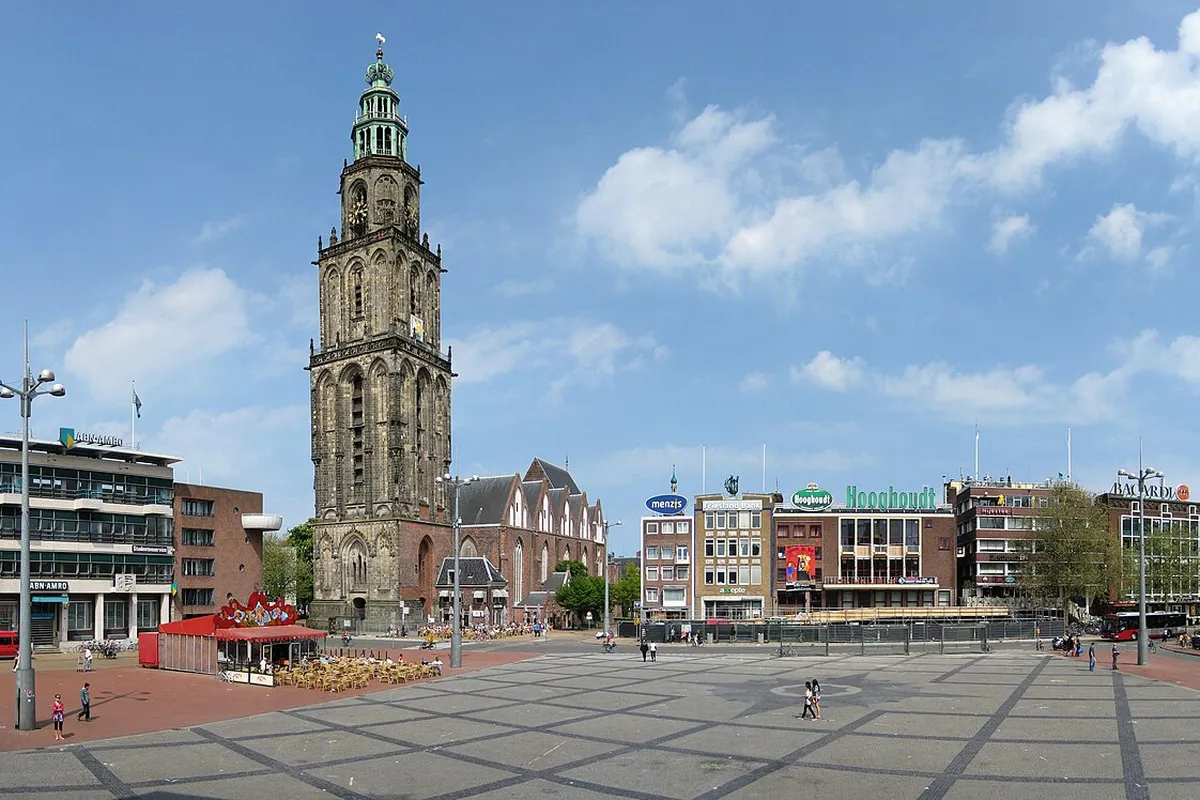 Photo: Groningen, the Netherlands. Source: Wikimedia Commons.
Groningen has a few facts that tend to surprise people. It is the Netherlands’ youngest city by average population age — roughly 25% of residents are students, which shapes everything from the nightlife to the cycling infrastructure to the price of a beer. The University of Groningen (Rijksuniversiteit Groningen, or RUG) was founded in 1614 and consistently ranks among Europe’s top 100 universities. UMCG (University Medical Centre Groningen) is one of the Netherlands’ largest hospitals and a major research employer. The city has a significant international academic population, which means it is considerably more English-friendly than its location might suggest.
| Factor | Groningen | vs Amsterdam | vs Utrecht |
|---|---|---|---|
| Rent (2-bed) | €900-€1,300 | €1,700-€2,500 | €1,200-€1,800 |
| Population | 240,000 | 900,000 | 370,000 |
| Average age | ~29 years | ~38 years | ~35 years |
| Student share | ~25% | ~10% | ~18% |
| International community | Academic focus | Large, varied | Growing |
| Cycling culture | ⭐⭐⭐⭐⭐ | ⭐⭐⭐⭐ | ⭐⭐⭐⭐⭐ |
| Train to Amsterdam | 2h15 | — | 27 min |
| English-friendliness | Very good (academic) | Excellent | Very good |
| Noorderplantsoen | ✅ Large park | Vondelpark | Wilhelminapark |
| Cultural scene | Punches above weight | Extensive | Strong |
The Noorderplantsoen deserves a mention of its own. It is a large, beautifully maintained English-style park in the middle of the city — one of the best urban parks in the Netherlands — where in summer half of Groningen seems to descend with picnics, bikes, and dogs. If you need a single image of what makes this city liveable, the Noorderplantsoen on a warm Friday evening is it.
Neighbourhoods for Expats
Centrum — Central, Characterful, Expensive (for Groningen)
- Vibe: Historic centre, canals (diepenringen), independent shops, lively market squares
- Rent: €1,000-€1,600/month (2-bed)
- Best for: Singles, couples without children, those who want to walk everywhere
- Pros: Everything within 10 minutes, Groote Markt and Vismarkt nearby, excellent restaurant and bar scene
- Cons: Highest rents in the city, parking almost impossible, can be noisy near student areas
Helpman — Quiet, Green, Family-Friendly
- Vibe: Established residential neighbourhood, leafy streets, good schools
- Rent: €950-€1,400/month (2-bed)
- Best for: Families with children, those who want calm without being far out
- Pros: Beautiful green surroundings, near Stadspark (large municipal park), good primary schools, cycle to centre in 15 minutes
- Cons: Less nightlife, fewer amenities than Centrum, further from Zernike campus
Paddepoel — Affordable, Near Zernike, Popular with Researchers
- Vibe: Post-war residential, predominantly students and young professionals, practical rather than pretty
- Rent: €800-€1,200/month (2-bed)
- Best for: University and UMCG staff, those on tighter budgets, researchers at Zernike Campus
- Pros: Short cycle to Zernike campus and UMCG, affordable, good bus connections, functional neighbourhood with supermarkets and local shops
- Cons: Architecturally unremarkable, limited character compared to Centrum or Helpman
Selwerd — Residential, Good Value, Cycling Distance to Centre
- Vibe: Quiet, working-class roots, increasingly mixed, well-connected
- Rent: €750-€1,100/month (2-bed)
- Best for: Budget-conscious expats, those working at the university who want value
- Pros: Genuinely affordable, good cycling routes to centre and university, safe and quiet
- Cons: Less cosmopolitan feel, limited restaurant and café options locally
Hoornsemeer — Modern, Families, Newer Development
- Vibe: Contemporary housing development, families, newer construction
- Rent: €1,000-€1,400/month (3-bed)
- Best for: Families who want modern housing and space
- Pros: Newer buildings with better insulation, family-friendly, near water, parking available
- Cons: Less central, still developing community feel, less character than older neighbourhoods
Neighbourhood Comparison Table
| Neighbourhood | Typical Rent (2-bed) | Cycle to Centre | Cycle to Zernike | Best For |
|---|---|---|---|---|
| Centrum | €1,000-€1,600 | 0-5 min | 20 min | Singles, couples |
| Helpman | €950-€1,400 | 15 min | 30 min | Families |
| Paddepoel | €800-€1,200 | 20 min | 10 min | Researchers, budget |
| Selwerd | €750-€1,100 | 15 min | 15 min | Budget, professionals |
| Hoornsemeer | €1,000-€1,400 | 20 min | 25 min | Families, modern housing |
Housing Costs vs Amsterdam and the Randstad
Groningen’s rental market is genuinely affordable by Dutch standards. If you are coming from Amsterdam, Rotterdam, or Utrecht, the prices will feel almost unreasonably reasonable.
Rent by Property Type (2026)
| Property Type | Groningen | Amsterdam | Utrecht | Rotterdam |
|---|---|---|---|---|
| Studio / 1-bed | €650-€950 | €1,200-€1,700 | €1,000-€1,400 | €900-€1,300 |
| 2-bedroom apartment | €900-€1,300 | €1,700-€2,500 | €1,200-€1,800 | €1,100-€1,600 |
| 3-bedroom house | €1,200-€1,700 | €2,200-€3,500 | €1,600-€2,500 | €1,400-€2,200 |
On the buying side, Groningen’s property market is also considerably cheaper:
- Average per m²: €2,800-€4,200 (vs €6,500-€9,000 in Amsterdam)
- 2-bedroom apartment in Centrum: €220,000-€380,000
- 3-bedroom house in Helpman: €320,000-€500,000
The housing budget checker will show you what you can afford in Groningen based on your income and tax situation. For a full breakdown of the rental search process, our finding housing guide covers Funda, Pararius, local Groningen agents, and what documents you will need.
Cost of Living in Groningen
Groningen is substantially cheaper to live in than Amsterdam, and cheaper than most of the Randstad.
Monthly Budget Comparison
| Expense | Single | Couple | Family (2 kids) |
|---|---|---|---|
| Rent | €700-€1,000 | €900-€1,300 | €1,200-€1,700 |
| Utilities | €100-€150 | €130-€180 | €180-€250 |
| Groceries | €230-€320 | €380-€500 | €550-€750 |
| Transport | €50-€100 | €80-€130 | €100-€160 |
| Health insurance | €130 | €260 | €260 (kids free) |
| Internet + phone | €55-€75 | €55-€75 | €60-€80 |
| Entertainment | €80-€180 | €130-€220 | €150-€280 |
| Total | €1,345-€1,955 | €1,935-€2,665 | €2,500-€3,480 |
Everyday Costs
| Item | Groningen | Amsterdam | Utrecht |
|---|---|---|---|
| Coffee (café) | €2.80-€3.20 | €3.50-€4.00 | €3.20-€3.60 |
| Restaurant main course | €13-€18 | €20-€28 | €16-€22 |
| Monthly OV pass | €70-€90 | €90-€120 | €80-€100 |
| Beer in a bar | €3.50-€4.50 | €5.50-€6.50 | €4.50-€5.50 |
| Gym membership | €25-€38 | €40-€55 | €30-€42 |
| Weekly groceries (1 person) | €75-€115 | €90-€135 | €85-€130 |
For the full national picture, our cost of living guide breaks down all major Dutch cities side by side.
Transport
Getting Around Groningen
Groningen’s great strength for daily life is its cycling infrastructure. The city is flat, compact, and has some of the best separated cycle paths in the Netherlands — which is saying something. Most expats living in Groningen get by without a car entirely. The cycle from Centrum to Zernike Campus takes around 20 minutes; to UMCG, around 10 minutes; to the main train station, 5-15 minutes depending on where you are.
Public transport within Groningen:
- Bus — QBuzz operates the city and regional network; the R-net buses are frequent and cover most neighbourhoods well
- Night buses — Friday and Saturday nights, so no car needed after a late evening
- Cycling: OV-fiets bike rental at Groningen Centraal (€4.55/trip with OV-chipkaart)
Train Connections from Groningen
| Destination | Journey Time | Frequency |
|---|---|---|
| Amsterdam Centraal | 2h15 | Every 30 min |
| Utrecht Centraal | ~2h00 | Every 30 min |
| Rotterdam Centraal | ~2h45 | Every 30-60 min |
| Leeuwarden | 35 min | Every 30 min |
| Assen | 20 min | Every 30 min |
| Zwolle | 55 min | Every 30 min |
The train to Amsterdam (2 hours 15 minutes) is comfortable and runs reliably, but it is not a commute you want to do daily. Groningen works best for expats whose professional life is primarily local. For occasional trips to the Randstad — a client meeting, a weekend away, Schiphol — the train is absolutely fine.
Groningen Airport Eelde is a small regional airport about 10km south of the city. It has a handful of seasonal routes but for most international travel you will go via Amsterdam Schiphol.
The University and Zernike Campus
The University of Groningen (RUG) is the second-oldest university in the Netherlands and one of the most internationally oriented. It has produced two Nobel Prize winners (Heike Kamerlingh Onnes in 1913, Ben Feringa in 2016) and currently enrols around 36,000 students, of whom roughly 20% are international. The Faculty of Science and Engineering, Economics and Business, and Medicine (via UMCG) are all major employers of international staff and researchers.
Zernike Campus sits north of the city and is the main science, technology, and engineering campus. It houses:
- University of Groningen science faculties
- Hanze University of Applied Sciences
- Energy Academy Europe
- Research institutes including the Dutch Energy Academy
- Growing number of tech and energy-sector companies
The Zernike Campus is also home to the Energy Valley cluster — the northern Netherlands’ long-running strategy to transition from fossil gas extraction to renewable energy, which has drawn research funding, startup activity, and international expertise. For expats working in energy, sustainability, or the research institutions attached to this sector, Zernike is a genuine international hub.
UMCG (University Medical Centre Groningen) is one of the Netherlands’ largest and most internationally recognised hospital-university complexes. It employs around 13,000 people and draws medical researchers and specialists from across the world. Healthcare professionals and biomedical researchers moving to Groningen will find a genuinely international working environment.
International Community
Groningen’s international community is smaller than Amsterdam or The Hague but more cohesive than its size suggests. Because so many expats arrive for the same reason — the university, UMCG, or energy-sector research — there is a natural shared context that makes networking and social connection easier.
Practical support:
- Groningen International Welcome Center — Official support for internationals arriving to work or study
- InterNations Groningen — Monthly events, regular social calendar
- ESN (Erasmus Student Network) Groningen — Primarily for students but open to young expats and researchers
- RUG International Office — Support for university staff and their families
English in daily life: Groningen is highly English-friendly in academic and professional contexts. In local shops, restaurants, and everyday interactions, Dutch is more commonly the default than in Amsterdam — but most people, especially younger residents, switch to English without difficulty.
Cultural Life and Nightlife
Groningen’s cultural scene is disproportionate to its size, and this is directly connected to the student population.
Culture:
- Groninger Museum — One of the most architecturally distinctive museums in the Netherlands, with rotating exhibitions and a strong permanent collection
- Martini Church (Martinikerk) — 13th-century Gothic church with panoramic tower views over the city
- VERA — One of the best small music venues in the Netherlands; internationally respected
- Grand Theatre — Theatre, concerts, and dance performances
- Noorderzon Festival — Annual August performing arts festival in the Noorderplantsoen; genuinely excellent and very Groningen
- Eurosonic Noorderslag (ESNS) — Europe’s leading music showcase for emerging artists, held every January; brings the music industry to the city
Restaurants and food: Groningen has a restaurant scene that has improved significantly in recent years. The Poelestraat and Gedempte Zuiderdiep areas are the main dining and bar concentrations. There are good Indonesian, Middle Eastern, Japanese, and Italian options, as well as a growing number of coffee bars with a specialty roasting focus. By Amsterdam standards it is modest; by any other measure, it is very solid.
Nightlife: The student population means Groningen’s nightlife is active for a city of its size. Clubs are centred around the Peperstraat and Poelestraat. Student nights run most weekdays, not just weekends. If you are well past your student years and prefer a quieter evening, it is easy enough to avoid — but it is there if you want it.
Practical Steps for Moving to Groningen
Before Arrival
- Start your housing search on Pararius and Funda 6-8 weeks before arrival — good apartments go quickly
- Contact the Groningen International Welcome Center if you are arriving for a university or UMCG position
- Use the housing budget checker to confirm your affordable rent range
First Two Weeks
- Register at the Gemeente Groningen — this gives you your BSN number. Our BSN registration guide covers exactly what documents to bring and what to expect
- Open a Dutch bank account (you need your BSN — ABN AMRO, ING, and Rabobank all have branches in Groningen)
- Arrange health insurance — mandatory from your first day of work or residence
- Buy or rent a bicycle — a must, not optional
First Month
- Apply for DigiD (digital identity for Dutch government services)
- Register with a huisarts (GP) — your first point of contact for all healthcare
- Find Dutch language classes — the RUG Language Centre offers courses for internationals at various levels
- Explore by bike — the best way to learn the city
Honest Pros and Cons
I make a point of telling clients what they are actually getting into, not just the highlights.
What I genuinely like about Groningen:
- The affordability is real and significant. A well-paid researcher who struggles to rent a decent flat in Amsterdam can live comfortably in Groningen on the same salary
- The Noorderplantsoen is a special urban space — genuinely one of my favourite parks in the Netherlands
- The cycling infrastructure is excellent, even by Dutch standards
- The cultural scene, especially music (VERA, ESNS), punches far above its weight
- The international academic community is tight-knit and generally welcoming
- The student energy gives the city a liveliness that purely residential Dutch cities of the same size simply do not have
What you should be clear about before committing:
- Distance from the Randstad is real. Amsterdam is 2 hours 15 minutes, not a casual train ride. If you have a partner working in the west, or frequently need to be in Amsterdam for business, this matters. It is not impossible, but it changes your relationship with the rest of the country
- The gas extraction earthquakes. The Groningen province has experienced hundreds of small earthquakes as a result of decades of natural gas extraction from the Groningen Gas Field. The NAM has wound down extraction significantly, but minor seismic activity still occurs. The earthquakes are rarely dangerous, but they have caused significant property damage in rural areas east of the city, and the issue has genuinely affected the housing market and community confidence in parts of the province. In Groningen city itself, the risk and impact is considerably lower than in rural Loppersum or Appingedam, but it is dishonest not to mention it
- Weather. Groningen is in the northeast of the Netherlands, which means it gets the Dutch climate in its more pronounced form: grey, damp, and windy in winter, with cold easterly winds that feel more German than coastal. Summers can be genuinely lovely. But if you are coming from a warmer country, the winters in Groningen are longer and darker than most of the rest of the Netherlands
- Limited flight connections. Groningen Airport Eelde is small with few international routes. If you travel internationally often for work or need to visit family abroad regularly, the dependence on Amsterdam Schiphol (2+ hours away) adds friction
More City Guides
If you are comparing Groningen with other Dutch cities, these guides cover the same ground:
- Moving to Amsterdam — Capital city, everything available, costs to match
- Moving to Rotterdam — Architecture, port industry, more affordable than Amsterdam
- Moving to Utrecht — Central location, university city, the sweet spot for many expats
- Moving to The Hague — International institutions, government, beach access
- Finding Housing in the Netherlands — Full rental strategy for wherever you land
- Dutch Health Insurance Guide — Mandatory from day one, get this sorted early
- BSN Registration Guide — Your first administrative task after arrival
Last updated: March 2026.
Frequently Asked Questions
Is Groningen good for expats?
Groningen is an excellent choice for expats working at the University of Groningen, UMCG, or in the energy and research sectors. It is the Netherlands' youngest city by average age, with a large international academic community, genuinely affordable housing by Dutch standards, and a cultural scene that punches well above its size. The main challenge is distance from the Randstad — Amsterdam is 2 hours 15 minutes by train — which matters if your job or family requires regular travel south. For those who can work locally or remotely, the quality of life is high and the cost of living substantially lower than the west.
How much does it cost to live in Groningen?
Groningen is one of the most affordable Dutch cities. A single expat can expect: rent €700-€1,100 (1-bed), utilities €120-€170, groceries €230-€320, transport €60-€100, health insurance €130. Total: roughly €1,240-€1,820/month. A couple should budget €2,000-€2,800/month. These figures are 30-40% below Amsterdam and meaningfully below Utrecht or The Hague. Housing is the biggest saving — a two-bedroom apartment that would cost €1,800+ in Amsterdam typically rents for €1,000-€1,300 in Groningen.
What are the best neighbourhoods in Groningen for expats?
The most popular expat neighbourhoods are: Centrum (central, walkable, higher rent), Helpman (quiet, green, family-friendly, south of centre), Paddepoel (affordable, near Zernike campus, popular with researchers), Selwerd (residential, good value, cycling distance to university), and Hoornsemeer (newer development, families, modern housing). Most expats working at the university or UMCG choose Paddepoel or Selwerd for the short commute; families with children often prefer Helpman for the green surroundings and better schools.
How far is Groningen from Amsterdam?
Groningen is 2 hours 15 minutes from Amsterdam Centraal by direct Intercity train, with departures roughly every 30 minutes. To Rotterdam it is around 2 hours 45 minutes; to Utrecht around 2 hours. This is manageable for occasional trips but makes daily commuting to the Randstad impractical. The domestic airport Groningen Airport Eelde has limited connections — most international travel goes via Amsterdam Schiphol. Within the northern Netherlands, Leeuwarden is 35 minutes and Assen 20 minutes.