The first time I visited Leiden, I missed my stop. I was on the intercity train from Amsterdam, half-reading something on my phone, and when I finally looked up I caught a glimpse of a canal cutting through a row of old brick gable houses and thought: wait, where am I? By the time I realised it was Leiden, the doors had closed and I was heading to The Hague. I got off at Voorburg, crossed the platform, and came back.
I have told that story many times since, usually to clients who are weighing up where to settle in the western Netherlands. It always gets a knowing smile from the ones who already live there. Leiden has a way of stopping you mid-thought.
This guide covers everything a relocating expat needs to know about moving to Leiden: why people choose it, which neighbourhoods actually suit which lifestyles, what you will pay for housing, how to get around, and what the day-to-day reality looks like. I have worked with enough families and individuals here to be direct about both the appeal and the frustrations.
Why Leiden? The Case for the Netherlands’ Oldest University City
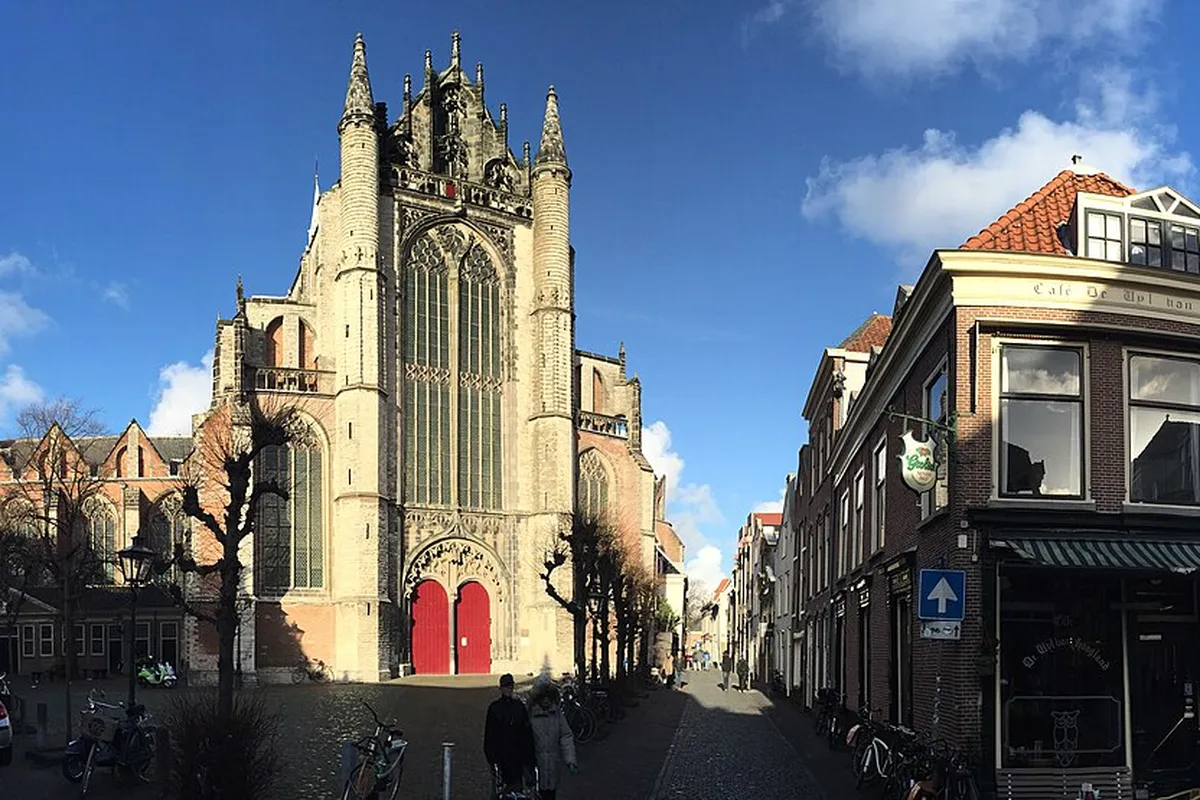 Photo: Leiden, the Netherlands. Source: Wikimedia Commons.
Leiden is not obvious in the way that Amsterdam is, or polished in the way that The Hague can feel. It is a mid-sized city of around 130,000 people that punches well above its weight — culturally, academically, and professionally.
Leiden University is the oldest in the Netherlands, founded in 1575, and it shapes virtually everything about the city. The student population of roughly 30,000 brings with it a constant churn of international academics, researchers, and postdocs. Around 40% of graduate students are international. That means the city is used to newcomers, culturally open, and genuinely multilingual in a way that smaller Dutch cities often are not.
Rembrandt was born here in 1606, and the city makes quiet, dignified use of that fact — a few plaques, a statue near his birthplace on the Weddesteeg, and good art in its museums. It is not overdone.
The location is what really drives the expat numbers. Leiden sits almost exactly between The Hague and Amsterdam, with fast rail connections to both. For families where one partner works at a ministry in The Hague and the other commutes to a tech company in Amsterdam, Leiden can genuinely serve both needs from one home address.
ESTEC — the European Space Research and Technology Centre, part of ESA — is located in Noordwijk, about 20 kilometres west of Leiden. It employs several thousand people from across Europe and beyond, many of whom base themselves in Leiden. The city’s biotech and pharmaceutical cluster (connected to the LUMC hospital and the university’s life sciences faculty) adds another layer of international professional life.
The historic canal network — more than 26 kilometres of waterways through a compact centre — makes the city genuinely beautiful in a way that becomes part of daily life rather than just a backdrop for tourism.
Leiden’s Neighbourhoods: Where to Look
Leiden’s neighbourhoods vary considerably in character, price, and practical suitability for expats. Here is an honest breakdown.
Binnenstad (City Centre)
The historic centre is where the canals, the old university buildings, the Pieterskerk, and most of the cafés and restaurants are concentrated. Living here means you are in the middle of everything: markets, museums, cycling distance to the station, and within walking range of the university faculties.
The catch is availability and price. Much of the Binnenstad housing stock consists of older buildings that have been converted to student accommodation or small apartments. Finding a spacious family home here is difficult. Rents are at the top end for Leiden. Parking is a serious problem — expect to pay €200–€300 per month for a permit or garage space.
Best for: Singles, couples without children, academics wanting walkable access to university buildings, people who prioritise character over square metres.
Leiden Noord
North of the railway line, Leiden Noord is more residential and considerably more affordable than the Binnenstad. The architecture is mostly mid-20th century, the feel is quieter, and you get meaningfully more space for your money. The area around the Leidse Hout park — a large green space with a lake — is particularly popular with young families.
The neighbourhood has improved significantly over the past decade and continues to do so. Shops and services are adequate, and cycling to the station takes around 10 minutes.
Best for: Families on a tighter budget, people who want more space, those prioritising green space over the historic centre.
Stevenshof
Stevenshof is a planned residential district in the east of Leiden, built primarily in the 1980s. It is quiet, green, and family-oriented in a thoroughly Dutch suburban way. Housing is spacious by Dutch standards, with many terraced houses and some semi-detached properties with gardens. Prices are among the lowest in Leiden.
The trade-off is that Stevenshof feels a little disconnected from the city’s social life. It is a 15–20 minute cycle to the centre, and the neighbourhood itself is not particularly interesting to walk around. That said, for families with children who want outdoor space and good local schools, it delivers.
Best for: Families with children, those prioritising space and quiet over urban energy, remote workers who do not need to commute within Leiden.
Roomburg
Roomburg is one of Leiden’s more diverse and lively neighbourhoods, situated to the south-east of the centre. It has a mix of housing types, reasonable prices, and is close to the Bio Science Park — which means short cycling times for those working in Leiden’s life sciences sector. The neighbourhood has a slightly rougher edge than Stevenshof or Merenwijk, but it is improving, and the lower prices reflect this trajectory.
Best for: Researchers and professionals at the Bio Science Park, buyers looking for relative value, people who want to be part of a genuinely mixed community.
Merenwijk
Merenwijk is another planned neighbourhood, built on the northern edge of the city beside a series of recreational lakes (the Meren). It is quieter and greener than most of Leiden, with good cycling infrastructure and a strong family feel. Some expats find it a little bland, but those with children often end up loving it.
Best for: Families with young children, people who enjoy water sports and outdoor recreation, those wanting a calm residential setting with good access to the A44.
Neighbourhood Comparison Table
| Neighbourhood | Character | Avg. Rent (1-bed) | Avg. Rent (3-bed) | Best For | Cycle to Station |
|---|---|---|---|---|---|
| Binnenstad | Historic, lively, dense | €1,300–€1,600 | €1,800–€2,400 | Singles, couples, academics | 5–10 min |
| Leiden Noord | Residential, improving | €1,050–€1,350 | €1,400–€1,900 | Young families, budget-conscious | 10–15 min |
| Stevenshof | Suburban, quiet, green | €1,000–€1,250 | €1,300–€1,750 | Families, remote workers | 20–25 min |
| Roomburg | Mixed, lively, affordable | €1,000–€1,300 | €1,350–€1,800 | Bio Science Park workers | 15–20 min |
| Merenwijk | Lake-side, calm, family | €1,050–€1,300 | €1,400–€1,900 | Families, outdoor enthusiasts | 20–30 min |
Rental figures are indicative as of early 2026. The Leiden market moves quickly — use these as orientation, not certainty.
Housing Costs and the Reality of the Market
Leiden’s housing market is competitive. The university creates permanent rental demand that keeps vacancy rates low, particularly for smaller apartments. The city’s appeal to professionals commuting to The Hague and Amsterdam adds further upward pressure.
Renting: A studio or one-bedroom apartment in a reasonable location typically costs €1,050–€1,500 per month, depending on location and condition. For a two-bedroom apartment suitable for a couple or small family, expect €1,400–€1,900. Three-bedroom family homes run from €1,600 to €2,400+ in more desirable areas. You will almost certainly need to show proof of income at least 3–4 times the monthly rent, and competition for good properties is fierce.
Buying: Average purchase prices in Leiden are around €4,200–€5,500 per square metre for the centre, with outer neighbourhoods coming in somewhat lower. A 3-bedroom terraced house in Stevenshof or Merenwijk might cost €350,000–€450,000. Something with character in the Binnenstad could easily reach €500,000–€750,000 or beyond.
Social housing: Leiden has a social housing waiting list that runs to many years. Unless you arrived with a social housing allocation, this is not a realistic option as a new expat.
For a realistic view of what you can afford in Leiden before you start searching, I recommend working through the Housing Budget Checker first. It helps you establish your rent or mortgage ceiling before estate agents start showing you things outside your range.
The broader process of finding a rental as an expat — what documents you need, how to read Dutch tenancy agreements, how to avoid being scammed — is covered in detail in my guide to finding housing in the Netherlands as an expat.
Getting Around: Transport Connections
Leiden’s transport links are one of its strongest arguments as a place to live.
By train: Leiden Centraal is a major station on the intercity network. Trains to The Hague Centraal run multiple times per hour and take around 10–15 minutes. Amsterdam Centraal is 35–40 minutes away. Rotterdam Centraal is about 35 minutes. Utrecht Centraal is around 45 minutes. For expats commuting to either of the Netherlands’ two main cities, this is about as well-placed as you can be outside those cities themselves. The station at Leiden Lammenschans (to the south-east) offers additional options for those living in Roomburg or the Bio Science Park area.
By bicycle: Leiden is extremely cyclable. The city centre is compact, flat, and well-served with dedicated cycle lanes. Most residents cycle to the station rather than take public transport within the city. For those new to Dutch cycling culture, Leiden is a good place to acclimatise — less aggressive than Amsterdam, more urban than smaller towns.
By car: The A44 connects Leiden to The Hague and Amsterdam. However, I would strongly caution against relying on a car for daily commuting in either direction. Traffic on the A4 and A44 is consistently heavy during peak hours. Parking in Leiden itself is expensive and restricted. The car is useful for weekend trips and reaching destinations not served by rail, but day-to-day, the train is almost always faster and less stressful.
To ESTEC/Noordwijk: ESA’s ESTEC campus is not on the rail network. Most people reach it by car (20–25 minutes from Leiden, traffic permitting), by bus (route 90 or 57 towards Noordwijk, around 35–45 minutes), or by e-bike for those who live close to the western edge of the city. Many ESTEC staff living in Leiden carpool, and there is an informal network for this.
The International Community
Leiden has a well-established international community, primarily built around two pillars: the university and the ESA/ESTEC ecosystem.
Leiden University has made a deliberate push towards internationalisation over the past 15 years, and the result is a city where English-language social events, international sports clubs, and expat networks are normal parts of the fabric. The university runs an international office that also provides some support for partners and family members of staff.
ESA/ESTEC staff — and the cluster of space industry suppliers around them — bring a particularly pan-European professional community centred on Noordwijk but largely resident in Leiden and surroundings. There are active social groups, family networks, and regular events.
Beyond these, Leiden has a growing biotech and pharmaceutical cluster (Janssen, Galapagos, and numerous smaller research companies operate in or around the city), which adds another international layer.
In practical terms, you will find it easy to meet other expats in Leiden. The harder work is integrating with Dutch residents, which takes more effort but is well worth pursuing. If you are still in the job search phase or negotiating an offer, the Salary Checker gives a useful benchmark for what professionals in your sector and experience bracket typically earn in this region.
Schools
As I noted in the FAQ below, Leiden itself does not have a dedicated international school within the city. For families with children requiring English-medium or IB-curriculum education, the main options are:
- International School of The Hague (ISH): The most commonly used option for expat families in Leiden. Offers Primary Years Programme, MYP, and IB Diploma. The train makes the commute manageable, though it adds time to the school run.
- Rijnlands Lyceum Oegstgeest: The international stream (TTO) at this school just outside Leiden is popular with bilingual families. It is a strong academic school and much easier to reach than ISH.
- American School of The Hague: Another option in The Hague for American curriculum families.
For Dutch-medium education, Leiden has a good range of primary and secondary schools. Children who arrive young tend to pick up Dutch remarkably quickly in a Dutch school environment, which many families find preferable to the international school route.
Healthcare: The LUMC Advantage
Leiden’s biggest healthcare asset is the Leiden University Medical Centre (LUMC), one of the eight university teaching hospitals in the Netherlands and a leading research hospital in Europe. Having LUMC on your doorstep is a genuine advantage for complex or specialist medical needs.
For day-to-day healthcare, the system works the same as anywhere in the Netherlands: you register with a GP (huisarts) who acts as the gateway to specialist care. English-speaking GPs are available in Leiden, though competition for places at popular practices is real. Register with a GP as soon as you arrive — do not wait until you need one.
You will also need to sort out Dutch health insurance (zorgverzekering) within four months of registering in the Netherlands. This is a legal requirement, and the fines for non-compliance are significant. The Health Insurance Wizard can help you identify the right level of cover for your situation and compare the main providers.
Culture, Museums, and Daily Life
Leiden has a cultural offer that is disproportionate to its size.
Rijksmuseum van Oudheden — the national museum of antiquities, located right in the centre — houses one of the finest Egyptian collections outside Cairo, including a complete reconstructed temple. Admission is around €17.50 for adults.
Naturalis Biodiversity Center — a stunning natural history museum with a real T-Rex skeleton (Trix) that was extensively discussed when it went on tour. It is genuinely world-class and a particular hit with children.
Museum Volkenkunde — the national museum of world cultures. Another major collection that most Leiden residents feel faintly smug about having within cycling distance.
Beyond museums, Leiden has a strong café culture (the kroeg scene around the Beestenmarkt is particularly lively), excellent markets (the Wednesday and Saturday markets are among the best in the western Netherlands), and a thriving restaurant scene that reflects the city’s international character.
The annual 3 October celebrations — commemorating the relief of Leiden’s siege in 1574 — are one of the more extraordinary local events in the Netherlands: a city-wide festival with herring and hutspot (the traditional meal eaten after the siege ended), fairground rides, and a genuine sense of civic pride that is infectious even if you have no idea what is happening.
Cost of Living: Honest Numbers
Leiden is cheaper than Amsterdam, more expensive than most of the Netherlands east of the A2. Here is a rough monthly budget breakdown for different household types. For a personalised estimate based on your household size and lifestyle, use the Cost of Living Calculator before committing to a location.
Single professional, renting 1-bed in Leiden Noord:
- Rent: €1,150–€1,300
- Health insurance: €140–€180
- Groceries: €250–€350
- Transport (NS OV-chipkaart): €80–€150 depending on commute
- Utilities (gas, electricity, water): €150–€200
- Miscellaneous (dining, culture, sport): €200–€400
- Total: approx. €2,000–€2,500/month
Family of four, renting 3-bed in Stevenshof:
- Rent: €1,450–€1,750
- Health insurance (2 adults): €280–€360
- Groceries: €600–€800
- School transport (if using ISH): €100–€150
- Utilities: €200–€300
- Car costs (if applicable): €400–€600
- Miscellaneous: €400–€600
- Total: approx. €3,500–€4,500/month
These figures do not include mortgage costs (if buying), savings, holidays, or childcare, which in the Netherlands can add €1,000–€2,000 per month for young children.
Honest Pros and Cons
What I genuinely like about Leiden for expats:
- The position between The Hague and Amsterdam is hard to beat for two-career families
- The university gives it an international character that most Dutch cities its size do not have
- The historic centre is beautiful and actually liveable, not just a tourist backdrop
- LUMC is a world-class medical facility on your doorstep
- The cycling infrastructure is excellent
- The cultural institutions (Naturalis, Rijksmuseum van Oudheden) are exceptional
What to be honest about:
- The housing market is competitive and prices have risen significantly in recent years
- Finding a good GP who is taking new patients requires patience
- No international school in the city itself — this matters for some families
- Parking in the centre is genuinely painful and expensive
- The city can feel very student-oriented in ways that do not always suit families or older professionals
- ESTEC commuters will find car dependency difficult to avoid entirely
Registering in Leiden: The Practical Steps
Once you have found a home and are ready to move in, registration at the municipality (gemeente) is legally required within five days of taking up residence. You will register at the Gemeente Leiden (city hall), and this will trigger your BSN (citizen service number) if you do not already have one. The BSN is necessary for almost everything in Dutch life — opening a bank account, accessing healthcare, receiving your salary. The BSN Planner walks you through what to prepare before your appointment at the gemeente.
My full guide to getting your BSN in the Netherlands walks through the process step by step, including what documents you need and how to handle the appointment.
Comparing Leiden to Other Cities
Leiden is not the right fit for everyone. If you are weighing up where to settle in the western Netherlands, these comparisons may help:
- Moving to The Hague: More international institutions, more embassies, slightly larger city feel, often more expensive in expat-popular areas. Better for those working directly in The Hague’s international organisations who want to live close to work.
- Moving to Amsterdam: More cosmopolitan and diverse, far more expensive, larger expat community, but also more competitive and more exhausting to settle into. Worth serious consideration only if your work or social ties genuinely centre there.
- Delft: Just 15 minutes south of Leiden by train, Delft is worth a look if you are drawn to the same canal-and-university character but want a slightly smaller, quieter city. It is particularly popular with TU Delft staff and students.
For most expats working anywhere along the The Hague–Amsterdam corridor, Leiden deserves serious consideration as the base. It is the kind of place where people arrive thinking they will stay two years and find themselves still there a decade later.
I am one of them.
FAQ
How expensive is housing in Leiden compared to Amsterdam?
Leiden is noticeably cheaper than Amsterdam, though the gap has been narrowing. A one-bedroom apartment in Leiden city centre typically costs between €1,100 and €1,500 per month to rent, compared to €1,500–€2,200 in Amsterdam. Buying property in Leiden averages around €4,200–€5,500 per square metre, versus €6,000–€8,000 in Amsterdam. That said, Leiden still commands a premium over smaller Dutch cities, largely because of the university, the LUMC hospital, and its excellent rail links.
Is Leiden a good city for expats working in The Hague or Amsterdam?
Yes — it is genuinely one of the best-positioned cities in the Netherlands for commuters. The train to The Hague Centraal takes around 10–15 minutes and runs several times per hour. Amsterdam Centraal is roughly 35–40 minutes away. Many expats working at international organisations in The Hague, such as the ICC, Europol, or the OPCW, choose to live in Leiden for its lower rents, canal-side charm, and lively social scene. It also works well for those commuting to ESTEC in Noordwijk, which is about 20–25 minutes by car.
Are there good international schools near Leiden?
Leiden does not have its own international school within the city, but there are well-regarded options within easy reach. The International School of The Hague (ISH) offers IB and British-style education and is about 20 minutes away by train. Rijnlands Lyceum Oegstgeest (which has an international stream) is also widely used by expat families in the area. For younger children, there are a handful of English-language nurseries and playgroups in Leiden itself.
Do I need to speak Dutch to live in Leiden?
Not immediately. Leiden has a large international population thanks to Leiden University and the biotech/pharma cluster, and English is widely spoken in shops, restaurants, and most services. That said, I always recommend putting serious effort into learning Dutch. It makes everything easier — from dealing with your landlord to seeing a GP — and the Dutch genuinely appreciate the effort. Leiden has good Dutch language course options, including through the Volksuniversiteit Leiden.
Sarah van den Berg is an expat coach and relocation specialist. Half Dutch, half British, she has lived in the Netherlands for over 10 years and has helped hundreds of expats settle into Dutch life. If you are planning a move to Leiden and want personalised advice, get in touch through the contact page.