In this guide
For a broader overview of relocating to the Netherlands, read our Complete Guide to Moving to the Netherlands 2026.
💡 Looking for a complete banking comparison? Read Best banking for expats in the Netherlands 2026 — covers ABN, ING, Bunq, Wise, Revolut & 5 others by expat use case.
Why Choose Rotterdam?
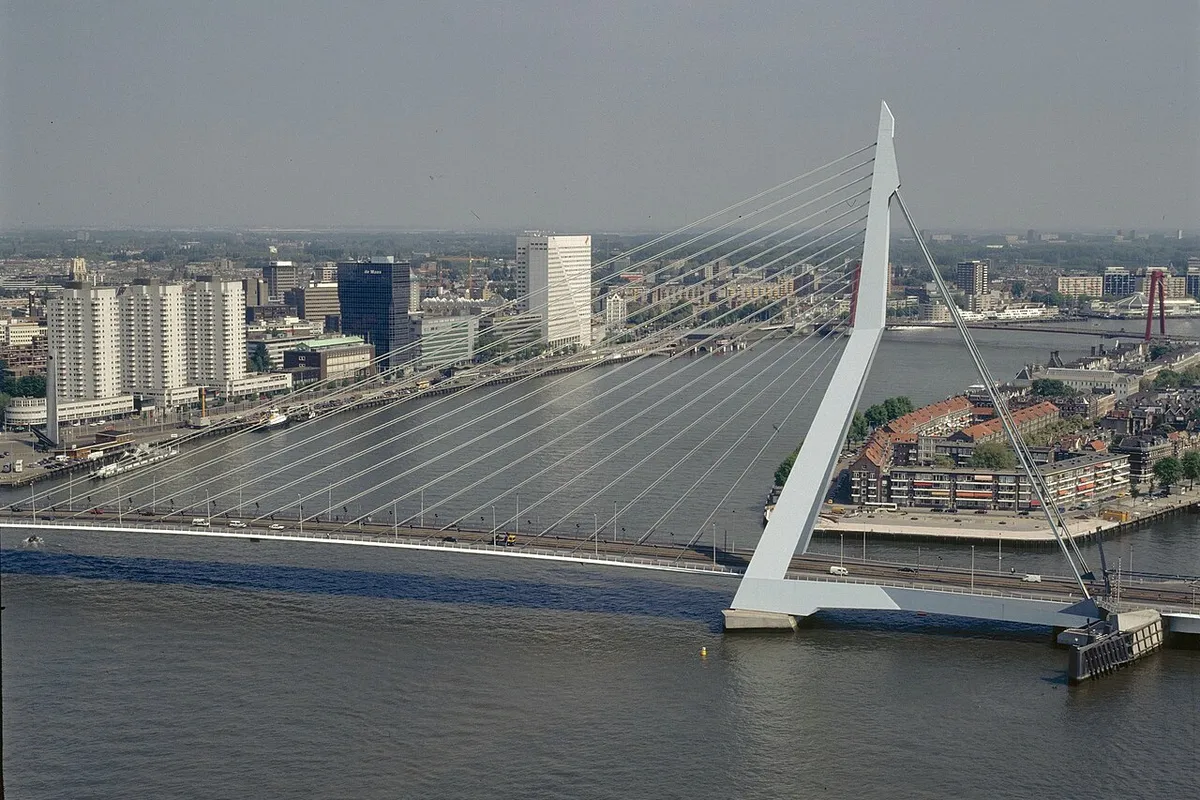 Photo: Rotterdam, the Netherlands. Source: Wikimedia Commons.
Rotterdam vs Amsterdam
| Factor | Rotterdam | Amsterdam |
|---|---|---|
| 1-bed rent (center) | EUR 1,000-1,500 | EUR 1,400-2,000 |
| 1-bed rent (outside) | EUR 800-1,200 | EUR 1,000-1,500 |
| Character | Modern, bold, diverse | Historic, touristy, charming |
| International community | Growing, welcoming | Large, established |
| English proficiency | High | Very high |
| Job market | Logistics, port, energy, tech | Tech, finance, creative |
| Architecture | Modern, bold | Classic, canal houses |
| Cycling | Excellent | Excellent |
| Nightlife | Growing, diverse | Extensive, world-class |
| Proximity to Amsterdam | 40 min by train | – |
Rotterdam is the right choice if you value affordability, modern urban living, diversity, and a city that feels authentic rather than touristy. Amsterdam is better if you prioritize a large expat community, classic Dutch aesthetics, and a wider range of international career options.
Before You Move
Visa and Employment
The same visa and work permit requirements apply as anywhere in the Netherlands:
- EU/EEA citizens: Free to live and work
- Non-EU citizens: Need a work permit (Highly Skilled Migrant visa is the most common route)
- 30% ruling: Available for eligible employees. Read our 30% ruling guide
Financial Setup
- Open a bank account: Set up a Wise account before arriving for a European IBAN. See our best bank accounts for expats guide.
- Budget for housing deposits: Expect 1-2 months’ deposit plus first month’s rent upfront.
- Arrange health insurance: Mandatory: take it out as soon as you can and no later than 4 months after arriving, with cover from the day you arrived (Government.nl). Read our health insurance guide.
- Transfer savings: Use Wise for the best exchange rates on international transfers. See our money transfer guide.
Open Your Free Wise Account Before Moving to Rotterdam
Finding Housing in Rotterdam
The Housing Market
Rotterdam’s housing market is competitive but significantly more accessible than Amsterdam’s. You have a better chance of finding quality housing at a reasonable price, and the search is less frantic. That said, the market has tightened in recent years, and popular neighborhoods go fast.
Average rents in 2026:
- 1-bedroom apartment (center): EUR 1,000-1,500/month
- 1-bedroom apartment (outside center): EUR 800-1,200/month
- 2-bedroom apartment (center): EUR 1,300-2,000/month
- 3-bedroom apartment: EUR 1,500-2,500/month
Where to Search
- Funda.nl: The primary Dutch housing platform
- Pararius.com: Expat-focused rental listings
- Kamernet.nl: Rooms and shared housing
- Housinganywhere.com: International-focused platform
- Facebook groups: “Rotterdam Housing” and “Expats in Rotterdam” groups
For a full guide, read our article on finding housing in the Netherlands.
Best Neighborhoods for Expats
Kralingen – Green, Upscale, and Central
Kralingen is Rotterdam’s most desirable residential neighborhood. Located east of the center, it surrounds the beautiful Kralingse Plas (a large lake with a park) and offers tree-lined streets, spacious apartments, and a village-like atmosphere within the city.
- Rent: EUR 1,100-1,700 for a 1-bedroom
- Vibe: Green, upscale, residential, student-friendly (near Erasmus University)
- Pros: Kralingse Bos park, quiet streets, excellent restaurants, close to Erasmus University
- Cons: Higher rents for Rotterdam, limited nightlife
Centrum – Urban Convenience
Rotterdam’s city center is compact and offers everything within walking or cycling distance: shops, restaurants, the Markthal, Witte de Withstraat (the cultural street), and Rotterdam Centraal station.
- Rent: EUR 1,100-1,600 for a 1-bedroom
- Vibe: Urban, vibrant, convenient
- Pros: Everything within reach, excellent transport, cultural venues, Markthal
- Cons: Can be noisy, less green, construction activity
Katendrecht – Trendy Waterfront
Katendrecht is Rotterdam’s most remarkable neighborhood transformation. Once a red-light district, it has become a trendy peninsula with waterfront restaurants, the Fenix Food Factory, and a mix of creative businesses and residential buildings.
- Rent: EUR 1,000-1,500 for a 1-bedroom
- Vibe: Trendy, waterfront, gentrifying
- Pros: Unique atmosphere, food scene, water views, SS Rotterdam hotel ship
- Cons: Limited daily shopping, still developing, can feel isolated
Delfshaven – Diverse and Authentic
Delfshaven is one of Rotterdam’s few surviving historic areas and is known for its diversity and authentic character. The neighborhood has an old harbor, independent shops, and a multicultural population. It offers some of the best value in central Rotterdam.
- Rent: EUR 800-1,200 for a 1-bedroom
- Vibe: Diverse, authentic, affordable
- Pros: Historic harbor area, affordable, multicultural food, charming streets
- Cons: Some areas feel less safe at night, infrastructure varies
Blijdorp – Family-Friendly
Blijdorp is a quiet, residential neighborhood north of the center, named after the famous Rotterdam Zoo. It is popular with families and young professionals who want a quieter environment with easy access to the city center.
- Rent: EUR 900-1,300 for a 1-bedroom
- Vibe: Family-friendly, quiet, residential
- Pros: Near the zoo, quiet streets, good schools, well-maintained parks
- Cons: Less exciting nightlife, further from the Maas river
Hillegersberg – Suburban Living
For expats with families who prefer a suburban atmosphere, Hillegersberg offers spacious housing, good schools, and a village-like feel while still being part of Rotterdam.
- Rent: EUR 1,000-1,600 for a 1-bedroom
- Vibe: Suburban, family-oriented, quiet
- Pros: Spacious houses, excellent schools, Bergse Plas lake, safe
- Cons: Requires transport to reach the center, less diverse
Registration and Bureaucracy
Registering at the Gemeente
Register at a Stadswinkel (City Office) within 5 days of arriving. Book an appointment at rotterdam.nl.
Bring with you:
- Valid passport or EU ID card
- Rental contract (with address details)
- Legalized birth certificate (apostilled and translated)
- Marriage certificate if applicable
- Employment contract (useful but not always required)
You receive your BSN (Burgerservicenummer) during or shortly after the registration appointment. This number is necessary for:
- Opening a Dutch bank account (with a traditional bank)
- Starting health insurance
- Employment and tax administration
- Government services
Expatcenter Rotterdam
If your employer is registered as a recognized sponsor, you may be able to use the Rotterdam Expat Centre for a faster, combined registration and immigration process. This can save significant time.
Getting Around Rotterdam
Cycling
Like all Dutch cities, Rotterdam is excellent for cycling. The city is flat, bike lanes are everywhere, and most destinations are reachable within 20 minutes by bike.
- Buy a bike: EUR 50-150 secondhand on Marktplaats.nl, or EUR 300+ new
- Swapfiets: Bicycle subscription starting at EUR 16.50/month
- OV-fiets: Rental bikes at train stations for EUR 4.55/24 hours
Public Transport (RET)
Rotterdam’s public transport is operated by RET and includes:
- Metro: 5 lines covering the city and suburbs (the oldest metro system in the Netherlands)
- Tram: Multiple lines connecting neighborhoods
- Bus: Full network covering the city and region
- Waterbus: Ferry service along the Maas and to Dordrecht/Kinderdijk
Use an OV-chipkaart for all public transport. Read our OV-chipkaart guide.
Train Connections
Rotterdam Centraal is a major railway hub:
- Amsterdam: 40-70 minutes
- The Hague: 12-25 minutes
- Utrecht: 35-40 minutes
- Breda: 25-30 minutes
- Brussels: 1 hour 45 minutes (Thalys/Eurostar)
- Paris: 2 hours 40 minutes (Eurostar)
Cost of Living in Rotterdam 2026
| Category | Monthly Cost (Single) | Monthly Cost (Couple) |
|---|---|---|
| Rent (1-bed, center) | EUR 1,000-1,500 | EUR 1,300-2,000 (2-bed) |
| Health insurance (average premium, Rijksoverheid) | EUR 157 | EUR 314 |
| Groceries | EUR 230-320 | EUR 370-500 |
| Dining out | EUR 80-200 | EUR 130-350 |
| Public transport | EUR 80-100 | EUR 160-200 |
| Utilities | EUR 140-230 | EUR 140-230 |
| Internet & phone | EUR 50-70 | EUR 50-70 |
| Total (excl. rent) | EUR 737-1,077 | EUR 1,164-1,664 |
For a full breakdown, see our Cost of Living in the Netherlands 2026 guide.
Working in Rotterdam
Key Industries
Rotterdam’s economy is anchored by:
- Port and logistics: The Port of Rotterdam is Europe’s largest and a massive employer
- Maritime: Shipbuilding, offshore energy, maritime services
- Energy: Shell, traditional and renewable energy companies
- Tech: Growing startup scene, especially in logistics-tech, fintech, and cleantech
- Architecture and design: Rotterdam is a UNESCO City of Architecture
- Medical: Erasmus MC is one of Europe’s leading university hospitals
- Education: Erasmus University Rotterdam is internationally renowned for economics and business
Finding Work
- LinkedIn: Primary platform for professional job searching in the Netherlands
- Indeed.nl: Large job board with international positions
- Undutchables: Recruitment agency specializing in multilingual positions
- Together Abroad: Job board for international professionals
- Rotterdam Partners: Information on working in Rotterdam
Learning Dutch in Rotterdam
While English is widely spoken, learning Dutch is more beneficial in Rotterdam than in Amsterdam. More daily interactions (shops, services, bureaucracy) happen in Dutch, and your social integration improves significantly with even basic Dutch skills.
Expat Community and Social Life
Meeting People
Rotterdam’s expat community is smaller but often described as more welcoming than Amsterdam’s. Tips for building a social life:
- Rotterdam Expat Events: Regular meetups and networking events
- WORM Rotterdam: Cultural center with international programming
- Sports clubs: Join a football team, rowing club, or running group
- Coworking spaces: 42workspace, Spaces, WeWork Rotterdam
- Meetup.com: Active groups for various interests
- Language cafes: Practice Dutch while meeting new people
Culture and Entertainment
Rotterdam offers a rich cultural scene:
- Museums: Kunsthal, Boijmans van Beuningen Depot, Nederlands Fotomuseum, Maritiem Museum
- Architecture: Cube Houses, Markthal, Erasmusbrug, De Rotterdam
- Music: North Sea Jazz Festival, Maassilo, Rotown
- Food: Markthal, Fenix Food Factory, Witte de Withstraat restaurants
- Events: Rotterdam Marathon, King’s Day, North Sea Jazz, Architecture Film Festival
- Day trips: Kinderdijk windmills (UNESCO), Delft, The Hague beach, Gouda
Practical Checklist: First 30 Days in Rotterdam
- Week 1: Register at Stadswinkel, receive BSN, open a bank account
- Week 1-2: Arrange health insurance, buy or rent a bicycle, get an OV-chipkaart
- Week 2: Set up internet and get a Dutch SIM card
- Week 2-3: Apply for DigiD, explore neighborhoods, find a supermarket routine
- Week 3-4: Join a Dutch language class, attend an expat meetup, discover local restaurants and parks
- Ongoing: Build your social network, learn Dutch, explore the city and beyond
Rotterdam vs Amsterdam: The Real Cost Comparison
The cost difference between Rotterdam and Amsterdam is not marginal. It is the kind of gap that, over a few years, means a different savings rate, a mortgage earlier, or a genuinely less stressed financial life. Here is what the numbers actually look like in 2026.
Rent Comparison
| Property type | Rotterdam | Amsterdam | Saving |
|---|---|---|---|
| Studio / 1-bed (centre) | €1,000-€1,500 | €1,400-€2,000 | ~25-30% |
| 1-bed (outer areas) | €800-€1,200 | €1,100-€1,600 | ~25% |
| 2-bed (centre) | €1,300-€2,000 | €1,800-€2,800 | ~25-30% |
| 3-bed family | €1,500-€2,500 | €2,200-€3,500 | ~25-30% |
| Buying (per m²) | €3,500-€5,500 | €6,500-€9,000 | ~40% |
On a €70,000 salary, you might pay €1,300/month for a comfortable two-bedroom in Kralingen or Delfshaven. The equivalent in Amsterdam’s De Pijp would be €1,900-€2,200. That €600-€900/month difference — €7,200-€10,800/year — is not trivial.
Neighbourhood Rent Breakdown (Rotterdam, 2026)
| Neighbourhood | 1-bed | 2-bed | Character |
|---|---|---|---|
| Kralingen | €1,100-€1,600 | €1,400-€2,000 | Green, upscale |
| Centrum | €1,100-€1,600 | €1,300-€1,900 | Urban, convenient |
| Katendrecht | €1,000-€1,500 | €1,200-€1,800 | Trendy, waterfront |
| Delfshaven | €750-€1,100 | €900-€1,400 | Diverse, affordable |
| Blijdorp | €850-€1,250 | €1,000-€1,500 | Family-friendly |
| Hillegersberg | €950-€1,400 | €1,200-€1,700 | Suburban, spacious |
Everyday Cost Comparison
| Item | Rotterdam | Amsterdam |
|---|---|---|
| Coffee (café) | €3.00 | €3.50 |
| Restaurant main course | €15-€20 | €20-€28 |
| Beer in a bar | €4.00-€5.00 | €5.50-€6.50 |
| Monthly OV | €80-€100 | €90-€120 |
| Gym membership | €28-€40 | €40-€55 |
Tools for Your Rotterdam Move
Housing Budget Checker
Even in Rotterdam, where rents are more reasonable, it is easy to overspend on housing in your first months — before you fully understand Dutch tax and the income requirements. The housing budget checker takes your gross salary and shows your realistic monthly housing budget after Dutch income tax, health insurance, and (if applicable) the 30% ruling. It is particularly useful if you are comparing Rotterdam to Amsterdam and want a like-for-like financial picture.
BSN Planner
Registration at the Rotterdam Stadswinkel and getting your BSN is the first admin task that makes everything else possible. The BSN Planner covers which documents to bring, how to book online at rotterdam.nl, and how to use the Rotterdam Expat Centre if your employer qualifies. It also covers what happens next — bank account, health insurance, employer HR — in the right order.
For a detailed guide to searching Rotterdam’s rental market, read our finding housing guide. And for a full cost comparison across Dutch cities, the cost of living guide covers Rotterdam in detail alongside Amsterdam, Utrecht, and The Hague.
Conclusion
Rotterdam is one of Europe’s most underrated cities for expats. It offers affordability that Amsterdam cannot match, a bold and modern urban environment, a strong job market anchored by the world-class port, and a growing international community that is welcoming to newcomers. The city has its own distinct identity – less polished than Amsterdam, more raw and energetic – and many expats who initially planned to live in Amsterdam end up preferring Rotterdam’s authentic character.
If you are considering a move to the Netherlands and want a city that combines quality of life with affordability, Rotterdam deserves serious consideration.
Start your preparation with our Complete Guide to Moving to the Netherlands 2026, and set up your finances with Wise before arriving.
Rotterdam’s Architecture: A City Worth Exploring
Rotterdam is genuinely the most architecturally interesting city in the Netherlands. The wholesale destruction of the city centre in the German bombing raid of May 1940 cleared the ground for something Amsterdam never had to do: rebuild from scratch. The result is a city that reads as a laboratory of twentieth and twenty-first century architecture.
A few highlights worth knowing:
Cube Houses (Kubuswoningen): Designed by Piet Blom in 1984, these tilted yellow cubes above the Blaak market are now iconic. One is open to the public as the Show Cube (Kijk-Kubus). The adjacent Markthal (2014) by MVRDV is equally striking — a horseshoe of apartments forming a vaulted indoor market with an enormous artwork on the ceiling.
Erasmusbrug: The 800-metre cable-stayed bridge over the Nieuwe Maas, opened in 1996, is affectionately known as the Swan (De Zwaan). It connects the north and south of the city and is Rotterdam’s most photographed landmark.
De Rotterdam: Also by Rem Koolhaas’s firm OMA, this massive “vertical city” on the Wilhelminapier opened in 2013. It contains offices, apartments, a hotel, and restaurants stacked in three linked towers.
The Wilhelminapier: The area where the Holland America Line ships once departed for New York. The Hotel New York, in the original HAL headquarters building, is the best lunch or dinner destination on the waterfront.
After two hours of that, Rotterdam’s distinct character tends to click into place.
Food and markets: Rotterdam’s Markthal (indoor market hall with over 100 food stalls, architect MVRDV, opened 2014) is the best single food destination in the Netherlands. The Albert Cuyp market in Amsterdam gets the press, but the Markthal beats it for variety, weather protection, and the sheer visual impact of the artwork on the ceiling. The Fenix Food Factory on Katendrecht is the alternative: a converted warehouse with specialty food producers, a microbrewery (Kaapse Brouwers), and a coffee roastery. The Rotterdam Fish Auction and the weekend Mariniersplein market fill out the picture. For a city that sometimes gets dismissed as purely industrial, the food culture is genuinely excellent.
Healthcare and Schools in Rotterdam
Healthcare: Rotterdam is home to Erasmus MC — one of Europe’s largest and most highly regarded university hospitals. The quality of specialist care available here is exceptional. For expats needing complex or specialist treatment, being in a city with this kind of medical infrastructure matters. Register with a GP (huisarts) promptly after arrival. For finding an English-speaking doctor in Rotterdam, see our English-speaking doctor guide.
International schools: Rotterdam has several international schools including ISR (International School Rotterdam), Albeda International College, and several bilingual (TTO) Dutch schools. The international schools guide covers the options in detail with fees, curriculum types, and admission processes. Apply early — particularly for ISR, which has waiting lists.
GP registration: Register with a huisarts as soon as you have your BSN and a Rotterdam address. The city has enough English-speaking GP practices that you should not need to compromise on language. Ask your employer’s HR department or your housing agency for a recommendation — their contact lists tend to be more current than public directories. Once registered, day-to-day healthcare access in Rotterdam is seamless and straightforward. For insurance, make sure you sign up for Dutch health insurance (zorgverzekering) within four months of arrival, and start comparing before you arrive.
Frequently Asked Questions
Is Rotterdam cheaper than Amsterdam?
Yes, significantly. Rent in Rotterdam is approximately 20-35% lower than in Amsterdam. A one-bedroom apartment in the center of Rotterdam costs EUR 1,000-1,500 per month compared to EUR 1,400-2,000 in Amsterdam. Groceries, dining out, and general living costs are also moderately lower.
Is Rotterdam a good city for expats?
Rotterdam is increasingly popular with expats who want the benefits of living in a major Dutch city without Amsterdam's prices and crowds. The city has a strong international community, modern architecture, excellent food scene, and good job market, especially in logistics, maritime, engineering, and tech.
Do people speak English in Rotterdam?
Yes, English is widely spoken in Rotterdam, especially among younger residents and in professional settings. However, the level of English proficiency is slightly lower than in Amsterdam, and learning basic Dutch is more beneficial here for daily interactions and integration.
What are the best neighborhoods in Rotterdam for expats?
Popular neighborhoods for expats include Kralingen (green, upscale), Centrum (urban, convenient), Delfshaven (diverse, affordable), Blijdorp (near the zoo, family-friendly), and Katendrecht (trendy, waterfront). Hillegersberg and Overschie offer suburban alternatives.
How do I get from Rotterdam to Amsterdam?
Direct intercity trains run between Rotterdam Centraal and Amsterdam Centraal every 10 minutes, with a travel time of approximately 40 minutes (intercity direct) to 70 minutes (regular intercity). A one-way ticket costs approximately EUR 17. Many Rotterdam residents commute to Amsterdam and vice versa.
What industries are strong in Rotterdam?
Rotterdam's economy is driven by its port (the largest in Europe), logistics, maritime, energy, engineering, and increasingly tech and creative industries. Major employers include the Port of Rotterdam Authority, Shell, Unilever, and numerous logistics and trading companies.
How do I register in Rotterdam?
Register at a Stadswinkel (City Office) within 5 days of arrival. Book an appointment online via rotterdam.nl. Bring your passport, rental contract, birth certificate (apostilled), and marriage certificate if applicable. You will receive your BSN at registration.